



| IN A NUTSHELL |
|
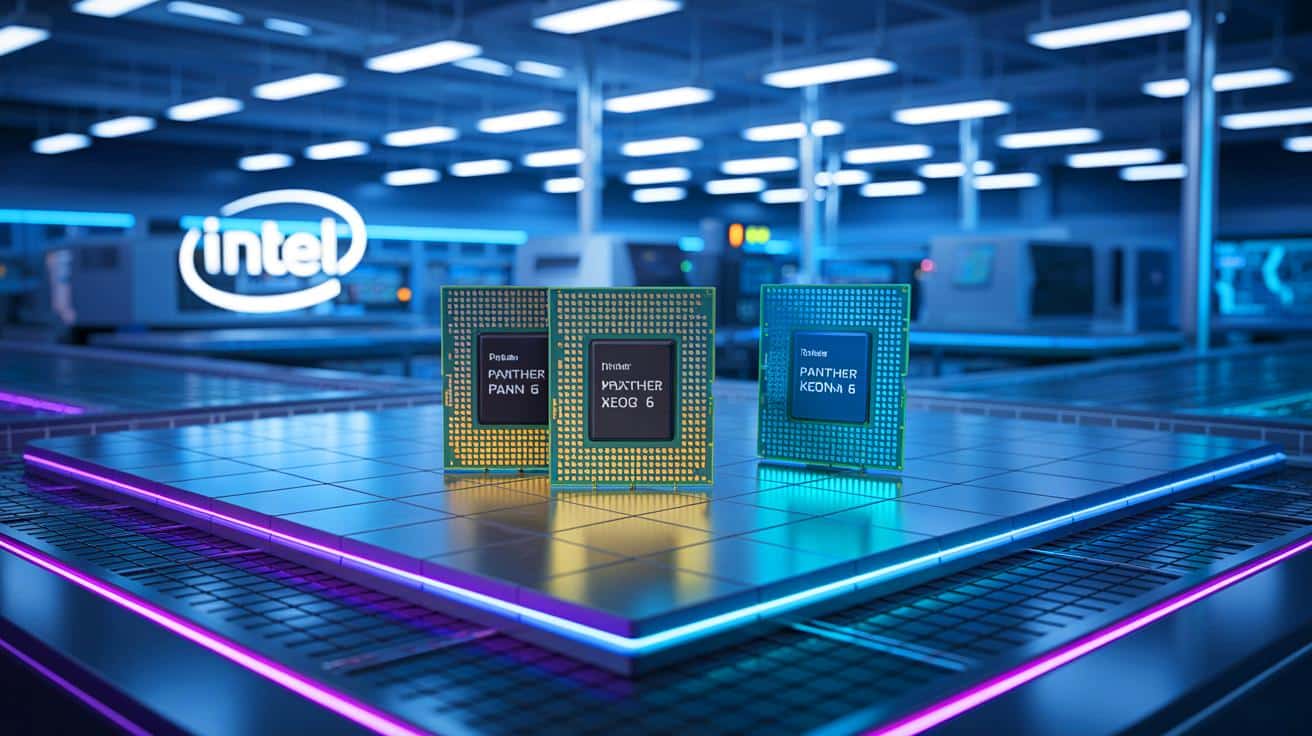
In a bold move to maintain its competitive edge in the semiconductor industry, Intel has introduced its latest advancements, the Panther Lake and Xeon 6+ chips. These groundbreaking chips, built on Intel’s cutting-edge 18A process, are set to power next-generation AI and edge computing technologies. Manufactured at Fab 52 in Chandler, Arizona, this development marks a significant leap in semiconductor technology, promising enhanced performance, energy efficiency, and advanced AI capabilities. Intel’s CEO, Lip-Bu Tan, emphasizes the transformative potential of these technologies, stating that they are poised to shape the future of computing for years to come.
Revolutionizing AI and Robotics
Panther Lake, part of the Intel Core Ultra series 3, is designed to redefine the capabilities of consumer and commercial AI PCs, gaming devices, and edge solutions. With high-volume production expected to commence later this year, the first units are anticipated to ship by the end of 2025. This series introduces a scalable, multi-chiplet architecture that offers flexibility across various form factors, segments, and price points. Panther Lake is equipped with up to 16 new performance-cores and efficient-cores, delivering over 50% faster CPU performance compared to its predecessor.
Additionally, a new Intel Arc GPU featuring up to 12 Xe cores promises a 50% improvement in graphics performance. The balanced XPU design delivers up to 180 TOPS for AI acceleration, making it a robust solution for demanding applications. Beyond PCs, Panther Lake is targeting innovative edge applications, including robotics, facilitated by the Intel Robotics AI software suite and a dedicated reference board. These advancements enable developers to create sophisticated AI capabilities for robotics, enhancing control and perception.
Intel 18A: Leading U.S. Innovation
Intel’s 18A process represents a significant milestone as the first 2-nanometer node developed and manufactured in the United States. This advanced technology boasts up to 15% better performance per watt and a 30% improvement in chip density compared to Intel 3. Key innovations include RibbonFET, a novel transistor architecture that facilitates efficient scaling, and PowerVia, a backside power delivery system that optimizes energy flow.
Foveros 3D chip stacking technology further enhances the integration of multiple chiplets, forming sophisticated system-on-chip designs suitable for both client and server applications. Panther Lake and Xeon 6+, as well as future generations, are expected to leverage these technological advancements, underscoring Intel’s commitment to pioneering semiconductor innovation.
Fab 52: A Milestone in U.S. Manufacturing
The production of Panther Lake and Xeon 6+ at Intel’s state-of-the-art Fab 52 in Chandler, Arizona, is a testament to Intel’s dedication to strengthening U.S. manufacturing capabilities. Part of a $100 billion investment to expand domestic operations, this facility is integral to maintaining a resilient semiconductor supply chain. It supports Intel’s product lines and serves foundry customers, reinforcing the company’s leadership in manufacturing.
Fab 52 builds upon Intel’s rich history of research and development and manufacturing advancements across Oregon, Arizona, and New Mexico. The facility is central to Intel’s strategy to provide advanced AI computing platforms while ensuring a reliable U.S. semiconductor supply base. As Intel continues to expand its domestic operations, it remains committed to driving innovation and maintaining its position as a technology leader.
The Future of Intel’s Semiconductor Strategy
The new Xeon 6+ chip, codenamed Clearwater Forest, marks Intel’s first server processor based on the Intel 18A process. Set for launch in the first half of 2026, it is tailored for hyperscale data centers, cloud providers, and telecommunications companies. With up to 288 E-cores and a 17% improvement in Instructions Per Cycle (IPC) over the previous generation, Xeon 6+ is designed to meet the demanding needs of modern data processing.
Intel’s commitment to innovation is further highlighted by its ongoing research and development efforts across the United States. According to CEO Lip-Bu Tan, “The United States has always been home to Intel’s most advanced R&D, product design, and manufacturing, and we are proud to build on this legacy.” As Intel continues to push the boundaries of semiconductor technology, the company’s influence on global computing standards is set to grow.
As Intel embarks on this ambitious journey, the implications for the semiconductor industry and technology landscape are profound. With the introduction of Panther Lake and Xeon 6+ chips, Intel is not only advancing its technological capabilities but also reinforcing its commitment to innovation and domestic manufacturing. How will these advancements shape the future of computing and influence the global semiconductor market? The answers to these questions will unfold in the years to come.