


Neutrino telescopes and the ice that makes them possible
Neutrinos cross almost everything in their path. This guide explains how a huge block of clear ice and buried light sensors turn rare collisions into observations.
 By
Callum Fairbairn
By
Callum Fairbairn
Some of the most important messengers in astronomy are also the hardest to catch. Neutrinos are tiny particles that stream out of stars, exploding stellar remnants and other violent places in space, and they cross planets, mountains and human bodies almost as if nothing were there. Building an instrument to detect them sounds like a contradiction, yet physicists have found a way, and it involves a very large block of very clear ice. This guide explains the idea in plain terms: what makes these particles so elusive, why polar ice is such a good place to look for them, and how a handful of rare collisions become scientific observations.
In brief
- Neutrinos are tiny particles that stream out of stars, exploding stellar remnants and other violent places in space, and they cross planets, mountains and human bodies almost as if nothing were there.
- What it sees is the aftermath of a rare collision.
- Anyone who follows news about neutrinos, whether from ice, water or underground tanks, can use the same simple frame: a particle that almost never interacts, a very large volume of material, and a lot of careful patience.
A particle that barely interacts
A neutrino has almost no mass and no electric charge. It responds only to the weak nuclear force and to gravity, which means it ignores the electromagnetic forces that make ordinary matter so good at stopping light and charged particles. A lump of lead thick enough to shield a room from other radiation hardly slows it down. Most neutrinos that reach the Earth from the Sun pass through the whole planet and emerge on the other side without any change.
That is a nuisance for the experimenter and a gift for the astronomer. Light from deep inside a star or from the heart of a distant galaxy is absorbed, scattered and bent on its way to us. A neutrino carries information straight from the place where it was made, because nothing gets in its way and no magnetic field pushes it off course. Its direction of arrival points back toward its source, which is exactly the property that astronomers want when they try to identify the engines behind the most energetic events in the universe.
Why ice makes a good detector
Because neutrinos so rarely interact, the only practical strategy is to watch a gigantic amount of material and wait. A laboratory tank is not big enough for the highest energies, which arrive far less often than the gentle neutrinos from the Sun. The solution is to use something that nature has already provided in vast quantity, and that is transparent enough for light to travel a long way through it.
Deep Antarctic ice fits that description. Under great pressure the air bubbles that cloud ordinary ice are squeezed out, and the result is a clear, dark, stable medium that can be instrumented from the surface. It sits far from city lights, radio noise and most sources of interference, and it does not move much, so equipment lowered into it stays where it was placed. Water and ice in other locations, such as deep lakes and seas, are used for the same purpose, with their own advantages and difficulties.
To build a detector, teams melt narrow holes into the ice with jets of hot water, lower long cables into each hole, and let the water freeze again around them. Each cable carries many light sensors spaced along its length, and the whole array together forms a three-dimensional grid inside the ice. Once the holes refreeze there is no way to repair a sensor, so the instruments must be reliable enough to run for many years without attention.
Reading the flashes of light
The detector never sees a neutrino directly. What it sees is the aftermath of a rare collision. Now and then a neutrino strikes an atomic nucleus in the ice and produces a shower of secondary particles, including electrically charged ones that travel faster than light does in ice. Those particles emit a faint blue glow, a bit like the shock wave of an aircraft moving faster than sound, and the sensors record the light as it spreads outward.
The pattern tells a story. The arrival time at each sensor reveals the direction of travel, and the amount of light reveals how much energy was involved. Different types of neutrino leave different signatures: some produce a long straight track, others a roughly round burst of light. By combining many sensor readings, the researchers can reconstruct where the particle came from and how energetic it was.
A great deal of the work lies in separating real signals from background. Cosmic rays hit the atmosphere above the detector and create showers of particles that also produce light in the ice, and these are far more common than the events of interest. Scientists use the Earth itself as a shield, selecting neutrinos that arrive from below after passing through the planet, and they apply careful statistical tools to decide which events are likely to have come from beyond the solar system.
What neutrino astronomy can reveal
The same questions that motivated the first cosmic-ray researchers are still open. Some particles hit the Earth with extraordinary energy, far beyond anything made in a laboratory accelerator, and nobody can yet say with certainty where they are produced. Neutrinos arrive as a by-product of the processes that accelerate those particles, so tracing them to a source helps identify the machines responsible. Candidates include the regions around supermassive black holes, the remains of massive stars and other extreme environments.
Neutrino observations also work well alongside other kinds of astronomy. When a detector flags an interesting event, it can alert telescopes that observe visible light, X-rays, gamma rays or gravitational waves, so that they can look in the same direction. Combining these messengers gives a richer picture than any one of them alone, and it is one of the reasons the field is described as multi-messenger astronomy.
There is a quieter benefit as well. The glacier itself is a record of past climate, and the techniques developed for drilling and instrumenting it feed back into polar science, engineering and research into how ice behaves under pressure.
Limits and open questions
Neutrino telescopes are blunt instruments compared with optical ones. Their angular resolution is limited, so a single event often points to a patch of sky rather than a pinpoint, and the faintest sources can only be found by accumulating many events over long periods. Patience is part of the method, and so is cooperation: larger arrays and complementary detectors in different places improve coverage and help check one another.
It also pays to remember how far this field has travelled. Not long ago the idea of using a block of ice as a telescope looked fanciful, and the sceptics had reasons for their doubts. The fact that the method works at all is a reminder that some of the best scientific tools come from asking where nature has already done most of the building. Anyone who follows news about neutrinos, whether from ice, water or underground tanks, can use the same simple frame: a particle that almost never interacts, a very large volume of material, and a lot of careful patience.
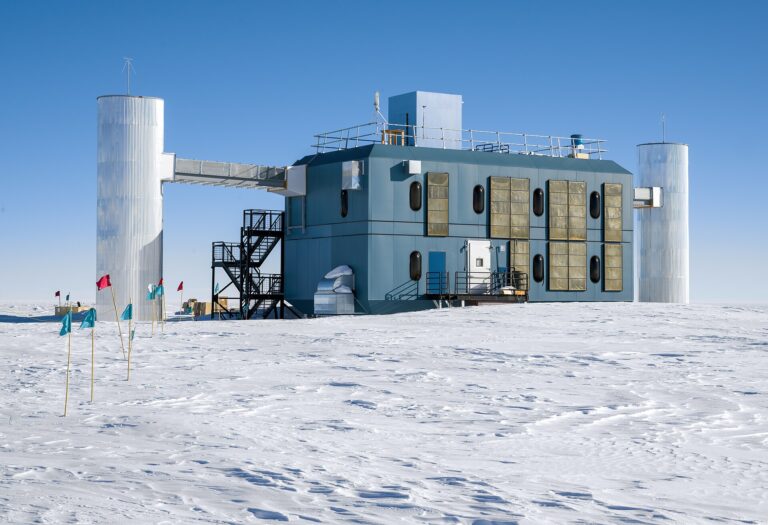
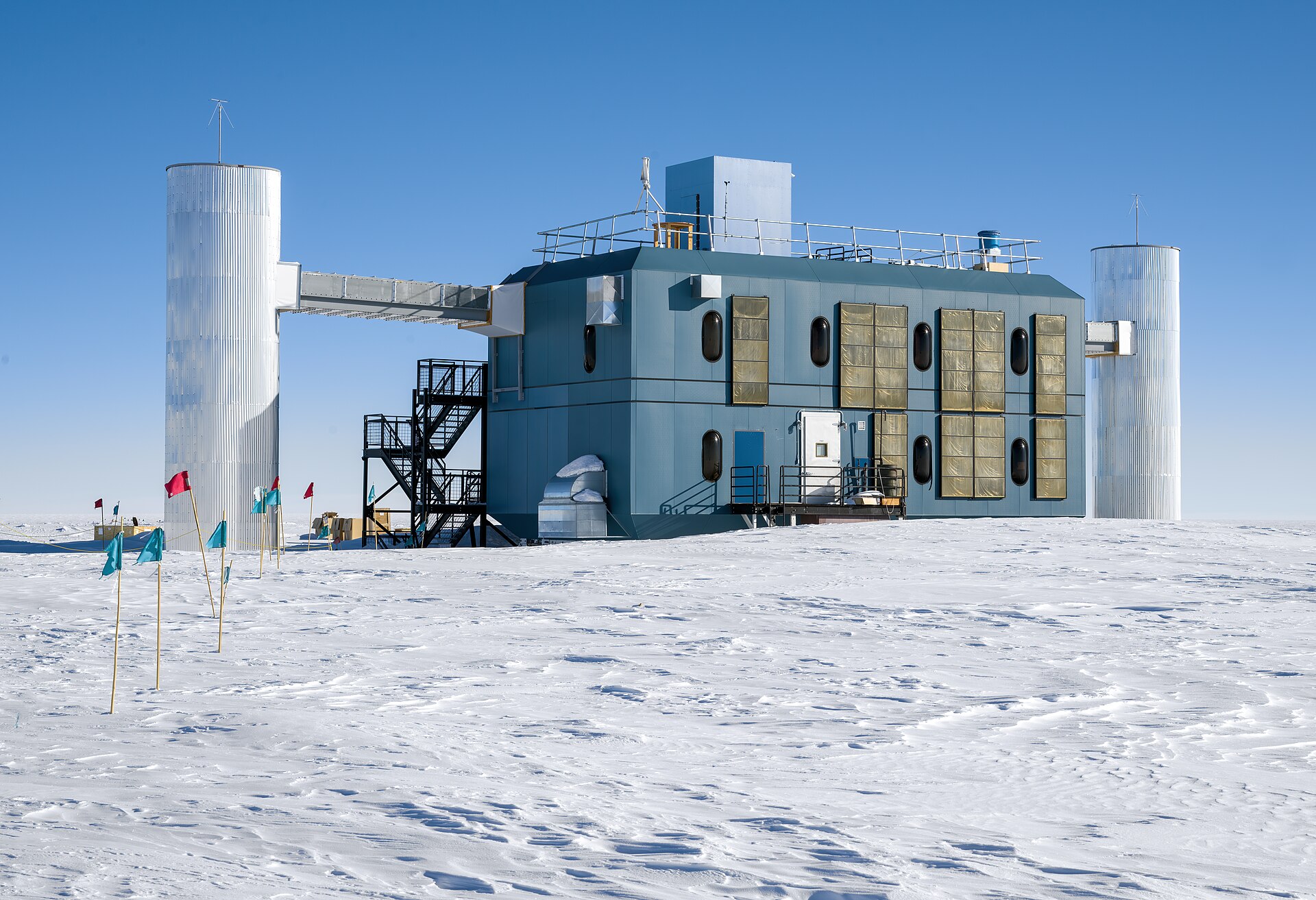
Featured image. Source: Wikimedia Commons. Credit: Christopher Michel. License: CC BY-SA 4.0.