




| IN A NUTSHELL |
|
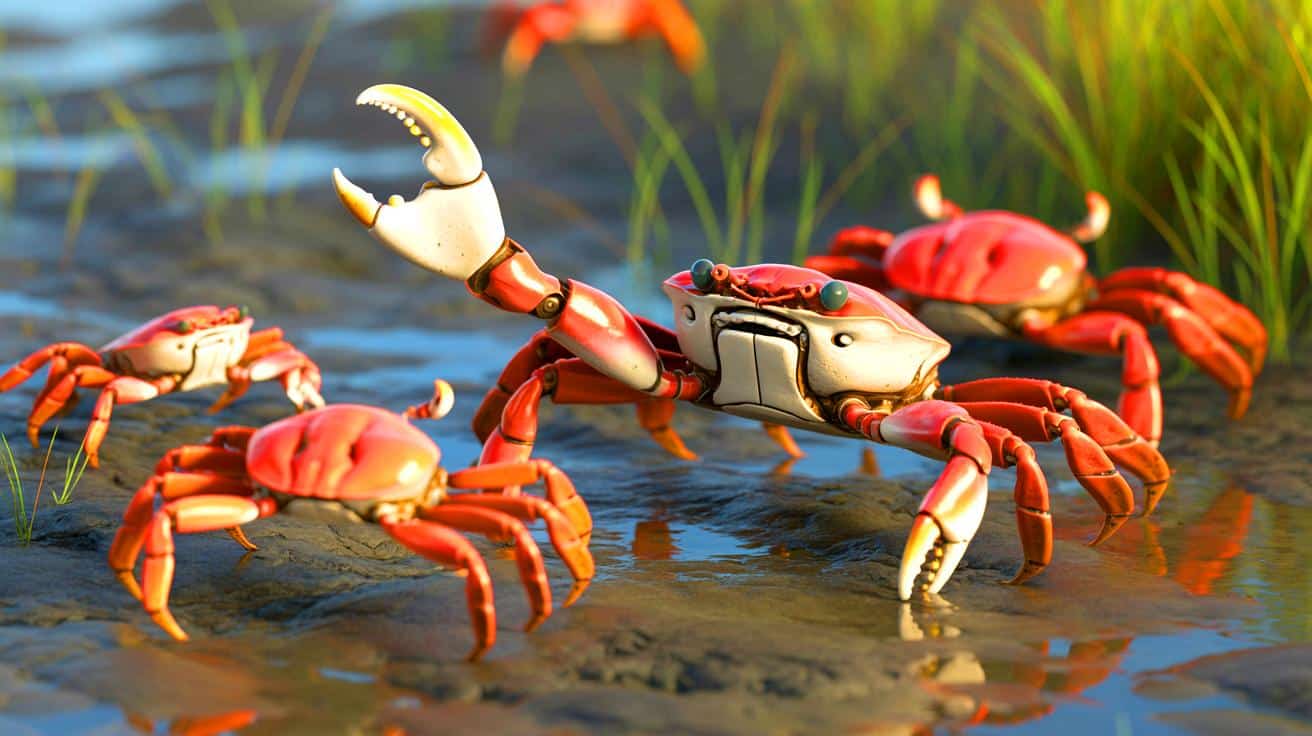
A recent study from the University of Exeter has shed light on the competitive world of male fiddler crabs, using a novel approach. Researchers deployed a robotic crab, known as Wavy Dave, to observe how these male crabs vie for female attention. This mechanical crab, with its 3D-printed body and waving claw, was sent to a mudflat in southern Portugal to interact with real fiddler crabs. The study aimed to explore how these creatures adjust their displays when a rival appears, providing insights into their intricate social behaviors.
Understanding Fiddler Crab Competition
Male fiddler crabs are known for their unique behavior of waving their oversized claws to attract females. This signaling is crucial in their mating rituals. But what happens when a competitor enters the scene? The researchers at the Centre for Research in Animal Behaviour (CRAB) sought to answer this question by positioning Wavy Dave near real male crabs.
Equipped with cameras, the team observed how the presence of this robotic rival influenced the fiddler crabs’ actions. The experiment revealed that the male crabs increased both the duration and intensity of their claw waving in response to Wavy Dave. This reaction was more pronounced when the robot had a smaller claw, suggesting that size influences competitive behavior.
“Our findings reveal the subtle ways in which these crabs adjust their behaviour to compete in a dynamic environment,” noted Dr. Joe Wilde. This adjustment is akin to market competition, where businesses adapt strategies in response to rivals.
The Unexpected Challenges of Wavy Dave
While most male fiddler crabs adjusted their signaling in the presence of the robot, not all interactions were peaceful. Some males perceived Wavy Dave as a genuine threat and reacted aggressively. One determined crab even managed to disarm the robot, pulling off its claw and forcing the team to halt the experiment temporarily.
This aggressive behavior highlights the stakes involved in these competitions. Male crabs are willing to go to great lengths to secure a mating opportunity. The presence of a larger claw in rivals often deterred confrontation, indicating that size is a significant factor in these interactions.
Such incidents underscore the complexity of animal behavior and the lengths to which creatures will go to secure their place in the social hierarchy.
Implications of the Study
The study offers fascinating insights into the social dynamics of fiddler crabs. Understanding these behaviors is essential for comprehending the broader ecological interactions within their habitats. The research also contributes to the growing body of knowledge on animal signaling and competition.
These findings have potential applications beyond biology. They could inform the development of robotic systems designed to study or interact with wildlife. By mimicking natural behaviors, robots like Wavy Dave can provide researchers with new tools to explore complex ecosystems without significant disruption.
The study, published in the Proceedings of the Royal Society B, emphasizes the importance of considering competitor presence in understanding animal behavior.
Future Directions for Research
The success of Wavy Dave opens avenues for further research into other species and environments. Future studies could explore how different environmental factors, such as habitat changes, influence competitive behaviors. There is also potential to investigate how females perceive these displays and what factors most influence their choice of mate.
Moreover, expanding the use of robotic models in ecological studies could offer new perspectives on animal interactions. By continuing to innovate in this area, scientists can deepen our understanding of the natural world and the intricate relationships within it.
The use of technology in ecological research is a promising field, providing novel insights into the behaviors and interactions of species across diverse environments.
The intriguing findings from the robotic crab experiment offer a glimpse into the competitive world of fiddler crabs. As researchers continue to explore these dynamics, they may uncover more about the interplay of competition and cooperation in nature. How might these insights influence our understanding of other complex animal behaviors in the future?