




| IN A NUTSHELL |
|
The relentless pursuit of innovation often leads to breakthroughs that redefine industries. Today, researchers at the University of Toronto have achieved such a milestone. They have developed a new non-stick coating that promises to revolutionize how we think about materials like Teflon. This new technology is as effective as traditional PFAS materials but without the associated environmental and health risks. By avoiding long-chain toxic molecules, this new development is poised to disrupt the dominance of Teflon and similar substances. Let’s delve into the science and implications of this groundbreaking discovery.
The Problem with Traditional Non-Stick Materials
Teflon and other PFAS (per- and polyfluoroalkyl substances) have long been favored for their ability to make cookware, packaging, and fabrics resistant to water and grease. However, these materials are more than just convenient; they are also notorious as “forever chemicals” because they do not break down in nature. Over time, they accumulate in the environment and the human body, posing serious health risks that include cancer, hormone disruption, and immune system impacts. The challenge has been finding a material that can perform like PFAS without the environmental baggage. Researchers have been racing to find alternatives that can offer the same level of performance without the detrimental side effects.
Now, a team from the University of Toronto has offered a promising solution. Their new coating repels water and oil as effectively as standard non-stick materials but contains only trace amounts of the least harmful PFAS variant. This breakthrough could signal the end of Teflon’s toxic dominance, paving the way for safer, sustainable alternatives.
Silicone Base with PFAS Twist
The innovation centers around the use of polydimethylsiloxane (PDMS), commonly known as silicone, which serves as the base for the new material. Professor Kevin Golovin, who leads the Durable Repellent Engineered Advanced Materials (DREAM) Lab, explains that PDMS is often used in biocompatible applications, such as medical implants. However, on its own, PDMS falls short when it comes to repelling oil and grease, a crucial feature for non-stick applications.
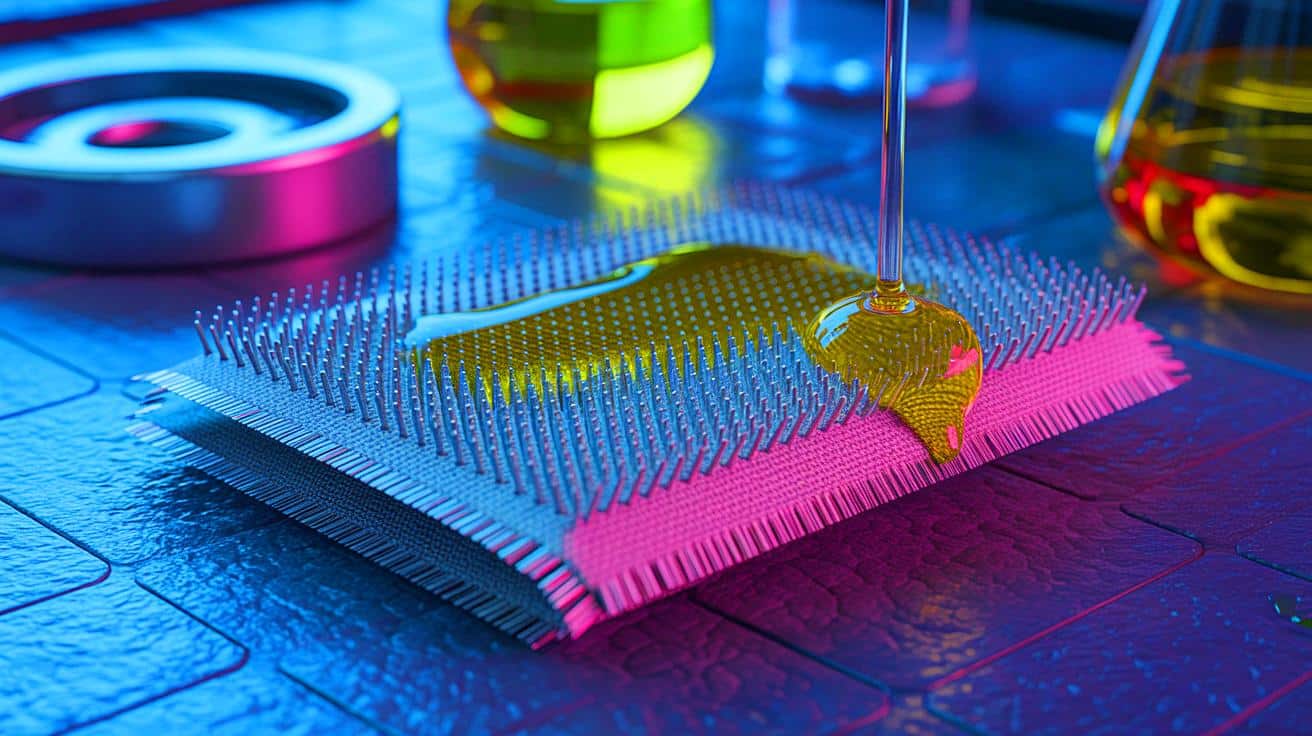
The breakthrough was achieved by PhD student Samuel Au, who developed a method called nanoscale fletching to enhance the material’s performance. By bonding short chains of PDMS to a base material, the team created a structure similar to the bristles on a brush. This structure was then enhanced by adding the shortest possible PFAS molecule, which consists of a single carbon atom bonded to three fluorine atoms. This combination allows the material to repel oil effectively while minimizing the environmental risks associated with long-chain PFAS.
Nanoscale Fletching for Enhanced Repellency
The concept of nanoscale fletching is as innovative as it is effective. Samuel Au describes it as akin to the feathers found at the back end of an arrow, helping to guide its flight. This meticulous design at the nanoscale level allows for enhanced repellency of oil and water. When tested, fabric coated with this material achieved a grade of six on the standard repellency scale used by the American Association of Textile Chemists and Colorists, comparable to many commercial PFAS-based coatings.
This achievement is significant because it demonstrates that the material can match the performance of traditional PFAS coatings without the environmental and health risks associated with long-chain molecules. This opens up a plethora of possibilities for industries reliant on non-stick materials, from cookware to fabrics, offering a safer alternative.
Low Risk and Potential for Commercialization
One of the most exciting aspects of this innovation is its commercial potential. Although the material uses a PFAS molecule, it is the shortest possible chain, which does not bioaccumulate, significantly reducing the associated risks. Professor Golovin states that the literature and regulations are increasingly focused on banning long-chain PFAS first, as these are considered more harmful. The new hybrid material offers the same performance as long-chain PFAS but with a much lower risk profile.
The team is eager to collaborate with manufacturers to scale up the process and bring this innovative product to market. While more research is needed to achieve the ultimate goal of a PFAS-free material that outperforms Teflon, this development is a critical step in that direction. As the study is published in the journal Nature Communications, the world watches eagerly for the next chapter in this revolutionary journey.
As we stand on the brink of a new era in material science, the implications of this discovery are vast. Could this be the beginning of the end for traditional non-stick materials? How might this technology evolve to further minimize environmental impact while maximizing performance? The future holds exciting possibilities, and only time will tell how this innovation will shape industries worldwide.