




| IN A NUTSHELL |
|
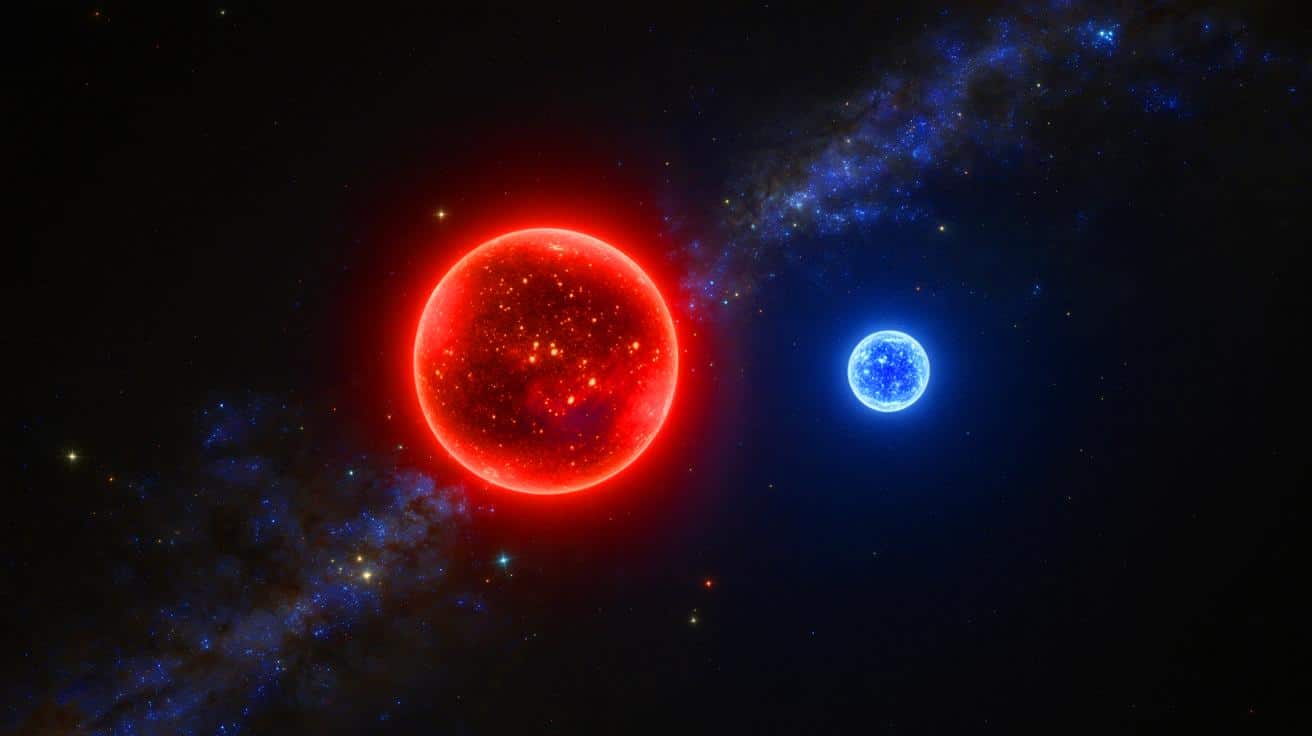
In a groundbreaking astronomical discovery, a hidden companion star has been found orbiting the majestic red supergiant, Betelgeuse. This revelation comes courtesy of advanced imaging techniques and the powerful capabilities of the Gemini North telescope. For centuries, Betelgeuse was thought to be a solitary giant, but recent findings have unveiled a stellar partner hiding in plain sight. This companion star, appearing blue in images, is likely an A- or B-type star, distinguished by its blue-white hue and high temperatures. This significant discovery not only reshapes our understanding of Betelgeuse but also offers fascinating insights into stellar dynamics.
Orbiting Within a Giant
The discovery of Betelgeuse’s companion star comes on the heels of the ‘Great Dimming’ event of 2019 and 2020, which saw the red supergiant’s brightness diminish dramatically. This mysterious dimming sparked widespread speculation about an impending supernova. However, it was later attributed to a colossal dust cloud obscuring the star. This event rekindled scientific curiosity, prompting researchers to delve into archival data, setting the stage for the breakthrough discovery.
Under the leadership of NASA Ames scientist Steve Howell, a team utilized the ‘Alopeke speckle imager to capture high-contrast images, revealing the elusive companion star. This star, approximately six magnitudes dimmer than Betelgeuse in visible light, orbits within the supergiant’s expansive atmosphere. Howell remarks on the unprecedented achievement, highlighting Gemini North’s high angular resolution capabilities that allowed astronomers to directly detect Betelgeuse’s companion for the first time. This discovery answers a centuries-old question regarding Betelgeuse’s periodic brightness changes and provides new insights into the behavior of variable red supergiants.
Sneak Peek by ‘Alopeke
The presence of a close-in stellar companion around a supergiant star marks a first in astronomical observations. Remarkably, this companion resides within Betelgeuse’s outer atmosphere, demonstrating the extraordinary resolving power of the ‘Alopeke imager. The discovery may finally explain Betelgeuse’s enigmatic six-year cycle of brightness fluctuations, with scientists long suspecting a hidden partner but lacking evidence until now.
Martin Still, NSF program director for the International Gemini Observatory, commended the speckle capabilities provided by the observatory, emphasizing their utility for a wide range of astronomical applications. The ability to deliver a solution to the Betelgeuse mystery, which has intrigued scientists for centuries, is hailed as a significant milestone. This finding enhances our understanding of how massive stars interact with close companions, influencing their evolutionary paths and eventual fate.
Implications for Stellar Evolution
Betelgeuse is nearing the end of its life cycle and is expected to culminate in a spectacular supernova within the next 100,000 years. However, the newly discovered companion star likely has a much shorter timeline. Tidal forces from Betelgeuse are expected to draw the companion inward, potentially leading to a dramatic merger within the next 10,000 years. This interaction will offer astronomers a rare opportunity to study the dynamics of such stellar pairs in detail.
Looking forward to November 2027, astronomers anticipate that the companion star will reach its furthest separation from Betelgeuse, presenting the clearest view yet. This will provide an exceptional chance to further understand the interactions and dynamics of this extraordinary stellar duo. The discovery is set to be published in The Astrophysical Journal Letters, marking a significant contribution to the field of astrophysics and stellar evolution.
The Role of Advanced Imaging Techniques
The breakthrough in detecting Betelgeuse’s companion star is largely attributed to advanced imaging techniques like speckle imaging. This method allows astronomers to counteract atmospheric distortions through rapid exposures, producing extremely sharp images of celestial objects. When combined with the Gemini North telescope’s 8.1-meter mirror, speckle imaging enabled a direct view of the elusive companion star nestled close to Betelgeuse.
These advancements in imaging technology not only facilitated the discovery of Betelgeuse’s companion but also paved the way for future explorations of other massive stars and their hidden partners. The ability to directly observe these celestial interactions holds immense potential for unraveling the mysteries of stellar formation and evolution, offering a promising horizon for astronomers worldwide.
The discovery of Betelgeuse’s hidden companion star marks a significant leap in our understanding of stellar dynamics and evolution. It highlights the capabilities of modern astronomical tools and techniques in unveiling the secrets of the universe. As we continue to explore the cosmos, what other mysteries of the stars remain hidden, waiting to be uncovered by the next generation of astronomers?