



| IN A NUTSHELL |
|
Germany is setting the stage for a revolutionary shift in fuel production through the innovative use of renewable resources. The H2Mare project, spearheaded by the Karlsruhe Institute of Technology (KIT), has launched a groundbreaking floating platform off the German coast. This pioneering project aims to produce synthetic fuels using wind energy, seawater, and ambient air. It marks a critical step forward in the quest for sustainable energy solutions and positions Germany as a leader in the field of offshore hydrogen production.
Floating Fuel Factory
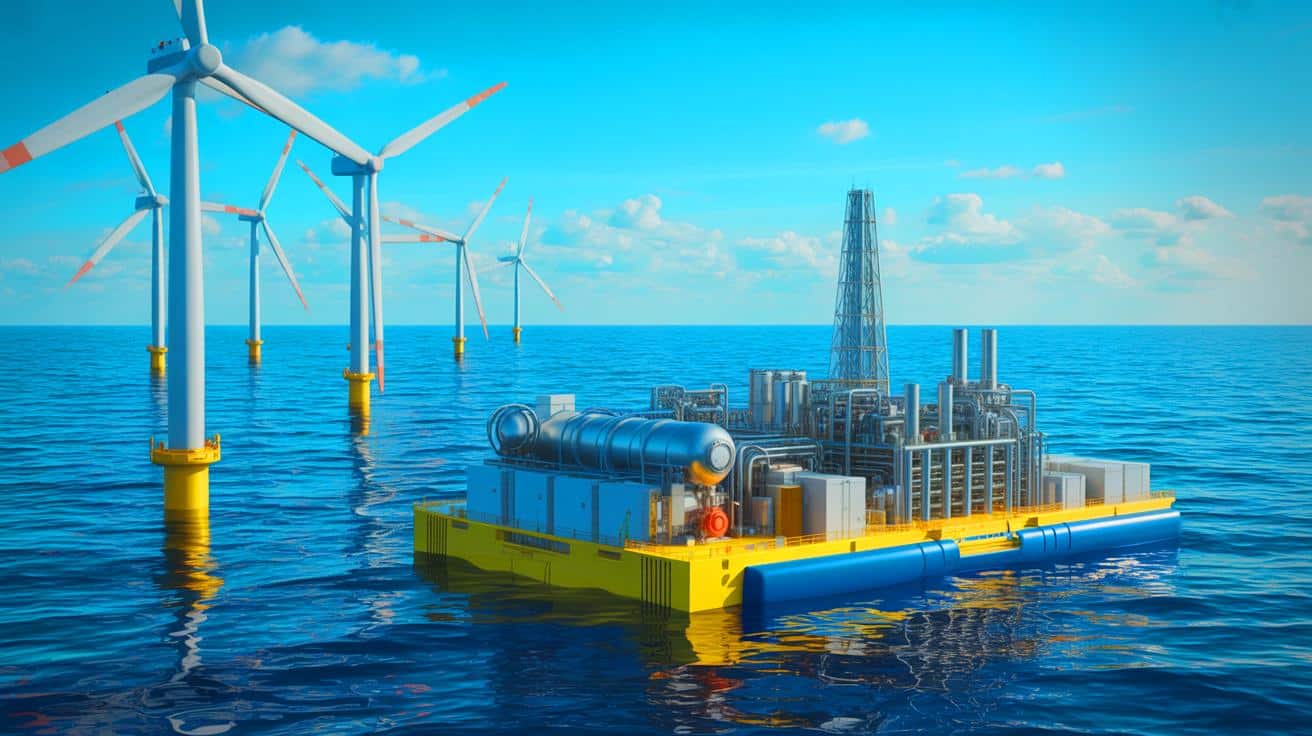
The heart of this initiative is a modular, off-grid plant installed on a floating barge, which is part of Germany’s H2Mare hydrogen lead project. This floating platform integrates a sophisticated system that includes a direct air capture unit for extracting CO₂ from the atmosphere, a desalination facility for converting seawater into freshwater, and a high-temperature electrolysis unit. These components work together to produce hydrogen-rich synthesis gas, which is then transformed into liquid synthetic fuels through the Fischer-Tropsch synthesis process.
The platform’s modular design allows it to operate independently of the traditional power grid, adapting dynamically to the fluctuating supply of offshore wind energy. Initial tests are set to begin in Bremerhaven’s port, with offshore deployment planned near Helgoland. Researchers will evaluate the process chain’s performance under real marine conditions, examining environmental impacts, material behavior, and legal frameworks for off-grid fuel production. Beyond synthetic fuels, the PtX-Wind team at KIT is exploring additional Power-to-X technologies, such as liquid methane and ammonia production, aiming to support larger-scale, wind-powered offshore platforms.
Wind-Driven Fuel
The H2Mare flagship project is driving forward offshore hydrogen production by exploiting the ideal conditions offered by wind energy at sea. Offshore wind turbines provide higher and more consistent outputs compared to their onshore counterparts, enabling more efficient and cost-effective green hydrogen generation. Funded by Germany’s Federal Ministry of Research, Technology, and Space (BMBH), H2Mare comprises several sub-projects focused on developing innovative offshore Power-to-X technologies.
A pivotal part of this initiative is the PtX-Wind project, led by KIT in collaboration with DLR and TU Berlin. This project explores the conversion of offshore green hydrogen into derivatives like e-fuels. By directly coupling electrolyzers with wind turbines, the project aims to eliminate the need for extensive grid infrastructure, thereby reducing production costs and alleviating stress on local grids. The H2Wind sub-project is adapting electrolyzers for marine environments, while OffgridWind is optimizing wind turbines for seamless integration with hydrogen systems.
Harnessing the Power of the Sea
In addition to synthetic fuels, the H2Mare project is investigating the production of green methanol and the use of seawater electrolysis to expand the offshore Power-to-X potential. These advancements aim to leverage the vast spatial availability of the sea and reduce reliance on freshwater, which is a critical resource in many parts of the world. While focusing on technological development, H2Mare is also committed to assessing safety, environmental impact, and lifecycle performance of these new technologies, ensuring a responsible transition towards sustainable energy.
The initiative’s collaborative approach brings together leading researchers and industry partners to explore the full potential of offshore renewable energy. This project not only highlights Germany’s commitment to achieving climate-neutral energy solutions but also sets a precedent for international efforts to mitigate climate change.
The Future of Offshore Energy
Germany’s H2Mare project represents a significant leap forward in the realm of renewable energy, particularly in the field of hydrogen production. By leveraging the natural resources available at sea, this initiative is poised to revolutionize the way we think about fuel production. The success of the project could pave the way for similar endeavors around the world, significantly contributing to the global effort to reduce carbon emissions and combat climate change.
As the world continues to grapple with the challenges of climate change and energy security, the importance of innovative solutions like those being developed through H2Mare cannot be overstated. How will this groundbreaking project influence the future of energy production, and what implications could it have for global energy policies?