



| IN A NUTSHELL |
|
In recent years, the global community has increasingly turned its attention to the mounting problem of plastic waste. The quest for sustainable solutions has led scientists to explore innovative avenues. One such promising development comes from the research of Federica Bertocchini at the Margarita Salas Center for Biological Research in Madrid, Spain. Her work focuses on the saliva of wax moth larvae, which demonstrates a remarkable capacity to break down polyethylene, a prevalent form of plastic. This discovery could pave the way for revolutionary biotechnological applications aimed at mitigating plastic pollution.
The Power of Enzymes
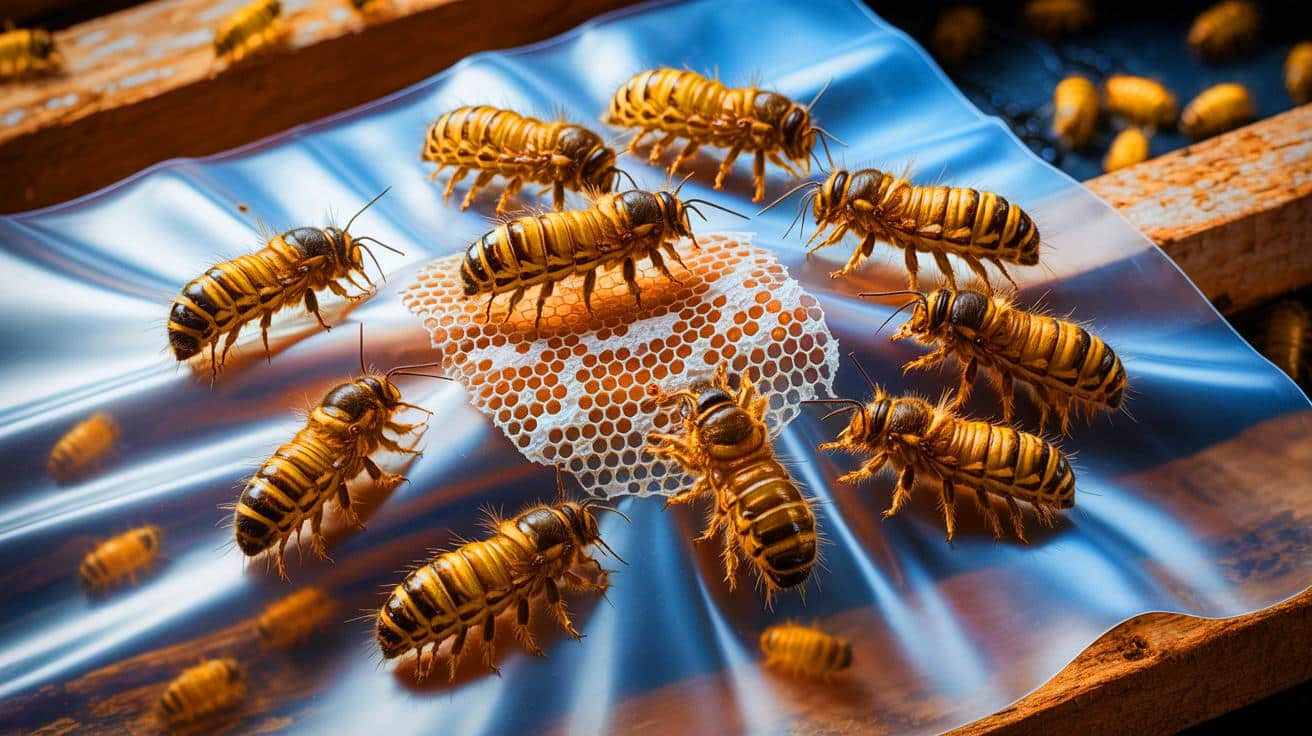
Could the solution to the plastic waste crisis lie in the humble saliva of wax moth larvae? This is the question that inspired Federica Bertocchini and her team to delve deeper into the capabilities of these unlikely organisms. The team’s research, published in Nature Communications, reveals that the larvae’s saliva contains two potent enzymes capable of degrading polyethylene. Remarkably, these enzymes can initiate the breakdown of plastic within hours, even at room temperature.
The discovery of these enzymes was serendipitous. Bertocchini, an amateur beekeeper, noticed that wax moth larvae had infested her stored honeycombs. When she placed the larvae in a plastic bag, she observed that the bag was quickly riddled with holes. Intrigued by this phenomenon, she embarked on a series of experiments to understand the underlying chemical processes. The findings suggest that the enzymes catalyze the oxidation of polyethylene, a process that could potentially be harnessed for large-scale plastic degradation.
Promising Prospects
The implications of Bertocchini’s research are vast. With polyethylene accounting for a significant portion of global plastic production and waste, the potential applications of these enzymes are manifold. One envisioned application is the integration of these enzymes into a liquid solution, which could be applied to plastics at waste disposal sites. This approach could prove particularly effective in regions where waste management and recycling infrastructure are lacking.
In 2019, global plastic production reached 460 million tons, with polyethylene constituting about 33% of this total. Yet, less than 10% of plastic waste is recycled, underscoring the urgent need for alternative solutions. The application of wax moth enzymes could provide a viable pathway for reducing plastic waste. Moreover, there is potential for these enzymes to be used domestically, allowing individuals to manage their own plastic waste effectively.
Broader Implications and Challenges
While the discovery of plastic-degrading enzymes in wax moth larvae is promising, several challenges remain before their widespread application can be realized. Scaling up the production of these enzymes for industrial use requires further research and development. Additionally, the environmental impact of deploying such enzymes on a large scale needs careful consideration to ensure that unintended ecological consequences are avoided.
Furthermore, the economic feasibility of enzyme-based plastic degradation must be evaluated. The petrochemical industry, which produces polyethylene, is deeply embedded in the global economy, and any shift towards biological degradation methods will require substantial investment and policy support. Nonetheless, the potential environmental benefits make this area of research a compelling focus for future innovation.
Future Directions in Plastic Waste Management
The discovery of plastic-degrading enzymes in wax moth larvae is just one piece of the puzzle in the complex issue of plastic waste management. As scientists continue to explore biotechnological solutions, it is crucial to integrate these findings into a broader strategy that includes waste reduction, recycling, and sustainable material development.
Collaboration across disciplines and industries will be essential to drive meaningful progress. Public awareness and consumer behavior also play critical roles in reducing plastic consumption and enhancing recycling efforts. As the world grapples with the environmental challenges posed by plastic waste, innovative solutions such as those discovered by Bertocchini offer a glimmer of hope for the future.
As scientists and policymakers work towards sustainable solutions, the question remains: How can society effectively integrate these promising scientific discoveries into everyday practices to combat the pervasive issue of plastic waste?