




| IN A NUTSHELL |
|
In a groundbreaking discovery, scientists have achieved what was once thought impossible: measuring the temperature of atoms in “warm dense matter” directly. This unprecedented experiment conducted by the SLAC National Accelerator Laboratory, in collaboration with the University of Nevada, Reno, has redefined our understanding of superheating. By employing ultrafast lasers and X-rays, researchers managed to bypass the so-called entropy catastrophe, challenging long-standing theories and pushing the boundaries of material science. This breakthrough not only offers insights into the behavior of materials under extreme conditions but also holds promise for advancements in fusion technology and planetary science.
Gold Breaks the Rules
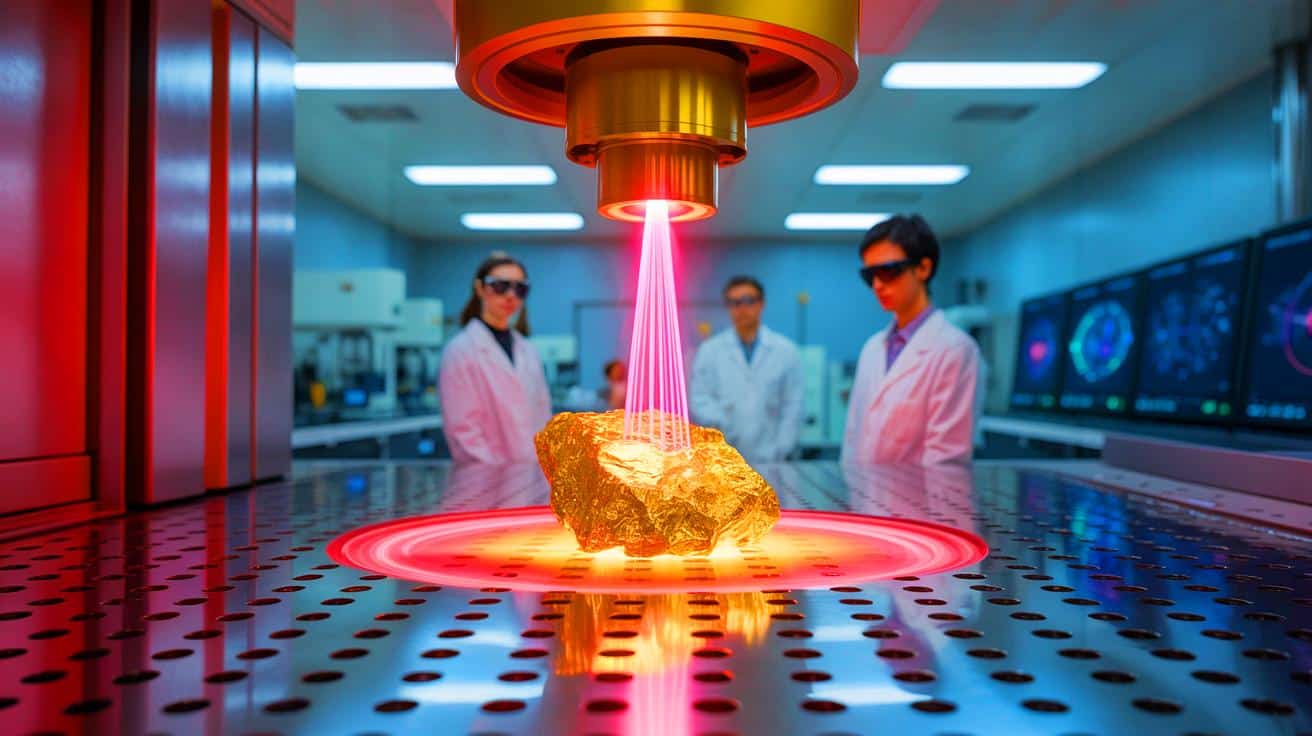
The conventional wisdom about gold and its melting point has been turned on its head. At the SLAC’s Matter in Extreme Conditions (MEC) instrument, scientists developed a novel method to superheat a gold sample just nanometers thick. Using a powerful laser, they raised its temperature to an astonishing 34,200 degrees Fahrenheit while maintaining its solid crystalline structure.
This temperature is 14 times higher than gold’s normal melting point of 2,063 degrees Fahrenheit, defying previous theories that solids should disintegrate at such extreme heat. By shining ultrabright X-rays on the superheated gold, the researchers gathered direct measurements of atomic vibrations, finally providing an accurate temperature reading. “Finally, we’ve directly and unambiguously taken a direct measurement,” stated Tom White, shedding light on a method that could revolutionize the field.
Implications for Fusion Science
This groundbreaking research challenges the entropy catastrophe, a theory suggesting that there’s a hard limit to how much heat solid matter can endure before melting or vaporizing. The experiment demonstrated that the gold didn’t break down because it was heated so rapidly, within trillionths of a second, that it retained its structure.
Researcher Bob Nagler emphasized that while the team did not violate the Second Law of Thermodynamics, they did show that these thermal limits could be circumvented through rapid heating. This finding opens up new possibilities for understanding materials in environments like planetary cores and fusion reactors, where temperature has been notoriously difficult to measure. Nagler expressed excitement for the future, noting, “If our first experiment using this technique led to a major challenge to established science, I can’t wait to see what other discoveries lie ahead.”
Revolutionizing Temperature Measurement
One of the key achievements of this study is the development of a technique to measure temperatures in extreme conditions directly. Previously, temperature estimates in high-pressure environments came with significant error margins, hindering theoretical models. This experiment provides a method that offers precise measurements, essential for advancing our understanding of extreme materials.
With applications in both scientific research and industrial processes, this technique could improve the accuracy of models predicting material behavior under extreme conditions. This advancement is crucial for developing technologies that operate at high temperatures, such as those found in fusion reactors, potentially paving the way for new energy solutions.
Future Prospects and Discoveries
As the scientific community delves deeper into this line of research, the potential for future discoveries is vast. The SLAC experiment not only challenges existing theories but also sets a precedent for future studies in material science and thermodynamics. With the ability to accurately measure temperatures in extreme environments, researchers can now explore the properties of other materials under similar conditions.
This breakthrough could lead to new materials capable of withstanding extreme conditions, benefiting industries ranging from aerospace to energy production. As we continue to push the boundaries of what is possible, the question remains: what other secrets might the elements reveal when subjected to the intense scrutiny of modern science?
With these groundbreaking findings, the scientific community stands on the brink of a new era in material science. The ability to accurately measure extreme temperatures could revolutionize our approach to studying matter in extreme conditions. As researchers continue to explore these frontiers, one must wonder: What other mysteries of the universe will we uncover as we delve deeper into the realm of extreme temperatures?