



| IN A NUTSHELL |
|
In a groundbreaking discovery, scientists have located an expansive hydrogen-rich hydrothermal system beneath the western Pacific Ocean. This system, identified as the Kunlun hydrothermal field, lies on the Caroline Plate and offers fresh insights into Earth’s subterranean processes. The discovery, led by researchers from the Institute of Oceanology of the Chinese Academy of Sciences (IOCAS), was made possible through the use of the crewed submersible, Fendouzhe. By examining this site, scientists hope to deepen our understanding of serpentinization, a chemical reaction between water and iron- and magnesium-rich rocks that is crucial for understanding both geological processes and the potential origins of life on Earth.
The Immense Scale of the Kunlun Hydrothermal Field
The Kunlun hydrothermal system is notable not only for its uniqueness but also for its sheer size. Located approximately 50 miles west of the Mussau Trench, it comprises 20 significant seafloor depressions. These depressions, some of which exceed half a mile in diameter, resemble a swarm of pipes that channel gases and liquids from beneath the Earth’s crust. The entire area spans around 4.3 square miles, making it over a hundred times larger than the Lost City, a well-known hydrothermal field in the Atlantic Ocean.
Professor SUN Weidong, the study’s corresponding author, emphasized,
“The Kunlun system stands out for its exceptionally high hydrogen flux, scale, and unique geological setting.”
This discovery challenges existing beliefs about where serpentinization-driven hydrogen generation can occur, suggesting that such processes are not confined to mid-ocean ridges alone.
Exploration of Larger Craters
The study, published in Science Advances, detailed explorations of four large craters conducted using the human-occupied vehicle, Fendouzhe. These craters, with depths reaching up to 427 feet, have steep walls akin to kimberlite pipes. Interestingly, the researchers observed rich ecosystems within smaller pits at the bases of these formations. Using advanced seafloor Raman spectroscopy, the team recorded hydrogen concentrations in the hydrothermal fluids ranging between 5.9 to 6.8 millimoles per kilogram.
The Kunlun field’s annual hydrogen output is estimated to be 4.8 × 10¹¹ mol/year, accounting for at least 5% of the global abiotic hydrogen emissions from all underwater sources. This significant contribution highlights the hydrothermal field’s importance in global hydrogen output and underscores its potential as a natural laboratory for understanding early Earth conditions.
Ecological and Geological Implications
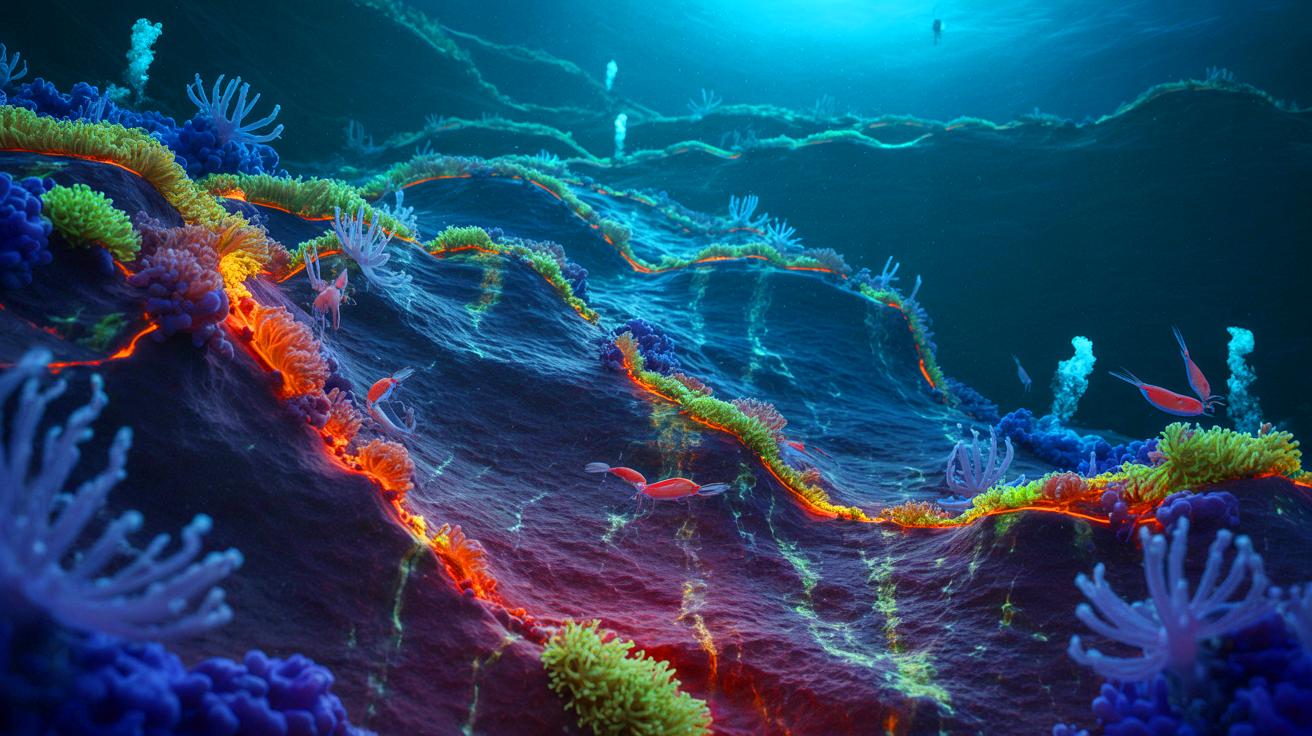
The geological characteristics of the Kunlun hydrothermal system, such as its steep-walled craters and explosive breccia deposits, indicate a complex evolutionary history. Initially driven by gas eruptions, the system has since been shaped by prolonged hydrothermal circulation and mineral deposition. This ongoing activity has created a rich environment that supports diverse deep-sea life.
Professor SUN noted the ecological significance, stating,
“What’s particularly intriguing is its ecological potential. We observed diverse deep-sea life thriving here, shrimp, squat lobsters, anemones, and tubeworms, species that may depend on hydrogen-fueled chemosynthesis.”
Scientists Claim “Universe’s First Molecule” Recreated in Lab Sparks Outrage Among Skeptics
These findings suggest that the Kunlun system could provide insights into the relationship between hydrogen emissions and the emergence of primitive life.
New Frontiers in Submarine Hydrogen Research
The Kunlun hydrothermal system’s discovery not only enhances our understanding of deep-sea hydrogen processes but also presents new opportunities for exploring untapped submarine hydrogen resources. The alkaline, hydrogen-rich fluids found at Kunlun are believed to closely resemble the chemical environment of early Earth, offering a window into the conditions that may have facilitated the origin of life.
As researchers continue to study this vast hydrothermal field, the knowledge gained could have profound implications for both science and industry. The potential for discovering new resources and understanding Earth’s geological history is immense, making the Kunlun system a focal point for future exploration and investigation.
The discovery of the Kunlun hydrothermal field opens a new chapter in the study of Earth’s deep-sea environments. As scientists delve deeper into this expansive system, questions about its role in the planet’s geological processes and its potential contributions to the origins of life remain. What other secrets might this vast underwater world reveal about our planet’s history and future?