




| IN A NUTSHELL |
|
The cosmos has always been a source of fascination, drawing in astronomers and enthusiasts alike. One of the most captivating phenomena within it is the quasar, a quasi-stellar object powered by supermassive black holes. These dazzling celestial bodies are not just the universe’s brightest beacons but also key to unraveling mysteries surrounding galaxy evolution and the early universe. Recent studies focusing on these luminous giants, especially through advanced telescopic surveys like MIGHTEE, have uncovered insights that could redefine our understanding of the cosmos, particularly in distinguishing between radio-loud and radio-quiet quasars.
The Role of MIGHTEE in Unveiling Cosmic Mysteries
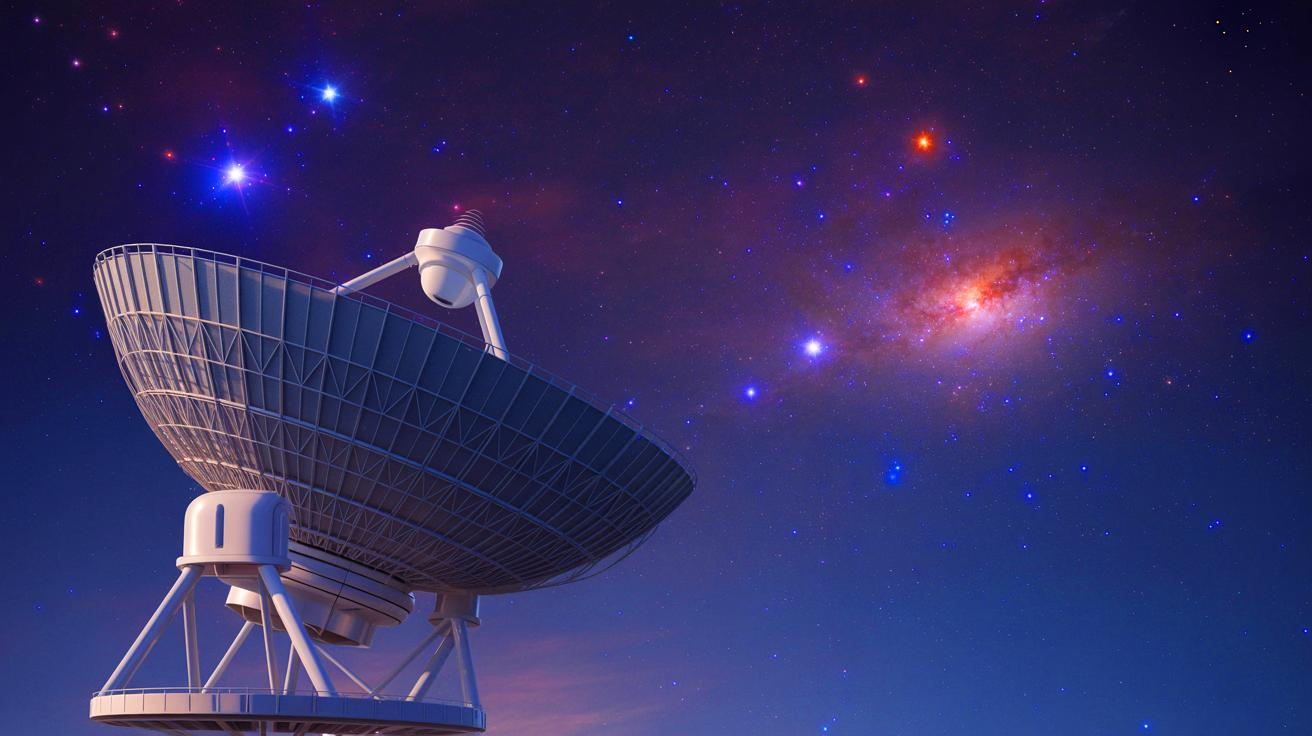
At the heart of recent quasar research is the MIGHTEE survey, an ambitious project utilizing the MeerKAT radio telescope in South Africa. This survey aims to create comprehensive, high-resolution maps of the extragalactic sky, offering a clearer picture of galaxy formation and evolution. The focus on quasars, especially through this project, has been transformative. Led by Sarah V. White from Rhodes University, a team of astronomers has leveraged data from MIGHTEE to study Type 1 quasars. These unobscured quasars, characterized by broad emission lines, provide a window into the universe’s distant past.
The researchers examined 104 quasars, analyzing data from the COSMOS and XMM-LSS regions of the sky. By integrating deep radio data with multiwavelength observations, they aimed to differentiate between radio emissions from black hole activity and those from star formation within the host galaxies. This meticulous approach has shed light on the diverse nature of quasars and their roles within their galactic environments, offering a nuanced understanding of these cosmic powerhouses.
Distinguishing Between Radio-Loud and Radio-Quiet Quasars
One of the study’s pivotal findings is the distinction between radio-loud and radio-quiet quasars. A mere 5% of the quasars analyzed were classified as radio-loud, echoing previous studies and reinforcing the idea that most quasars are relatively quiet in the radio spectrum. This categorization is crucial for astronomers as it helps determine the dominant processes occurring within these celestial bodies.
The researchers found that the quasars spanned a vast range of distances, with redshifts between 0.6 and 3.41, placing some billions of light-years away. The median redshift of 1.68 suggests that most of these quasars are observed as they were when the universe was less than half its current age. By focusing on these distant objects, scientists can piece together a timeline of cosmic evolution, tracing back the intricate dance of galaxies and their central black holes.
Sensitive Radio Data Reveals More Star-Forming Quasars
The enhanced sensitivity of the radio observations in this study has allowed astronomers to detect fainter radio sources, revealing that a greater fraction of quasars have radio emissions driven by star formation rather than active galactic nuclei (AGN). This discovery underscores the necessity of sensitive tools in astrophysical research, as it provides a more nuanced view of the radio properties of quasars, especially those with lower luminosities.
Interestingly, the study identified a trend where the proportion of quasars classified as potential starburst galaxies rises significantly with redshift. At lower redshifts, about 31 to 38% of quasars show starburst activity, which increases to 63% among the most distant sources. This finding challenges the traditional “radio-excess” method used to determine the main contributors to a galaxy’s radio emission. The overlap between AGN activity and star formation complicates the analysis, prompting researchers to seek more refined methods for future studies.
The Broader Implications for Astrophysics and Cosmology
The insights gained from studying quasars through the MIGHTEE survey extend beyond understanding these luminous objects. They have broader implications for astrophysics and cosmology, offering clues about the universe’s evolution and the processes that drive galaxy formation. By distinguishing between different sources of radio emissions, researchers can better model the behavior of galaxies and their central black holes, leading to more accurate simulations of cosmic phenomena.
Moreover, these findings highlight the importance of international collaboration and cutting-edge technology in advancing our knowledge of the universe. As astronomers continue to refine their methods and explore new frontiers, the mysteries of the cosmos become ever more accessible, inviting a deeper appreciation of the wonders that lie beyond our planet.
As we continue to explore the vastness of the universe, the study of quasars stands as a testament to human curiosity and ingenuity. These luminous objects not only illuminate the distant reaches of space but also guide our understanding of the cosmos. What new revelations might future technologies uncover about these enigmatic celestial bodies?