



| IN A NUTSHELL |
|
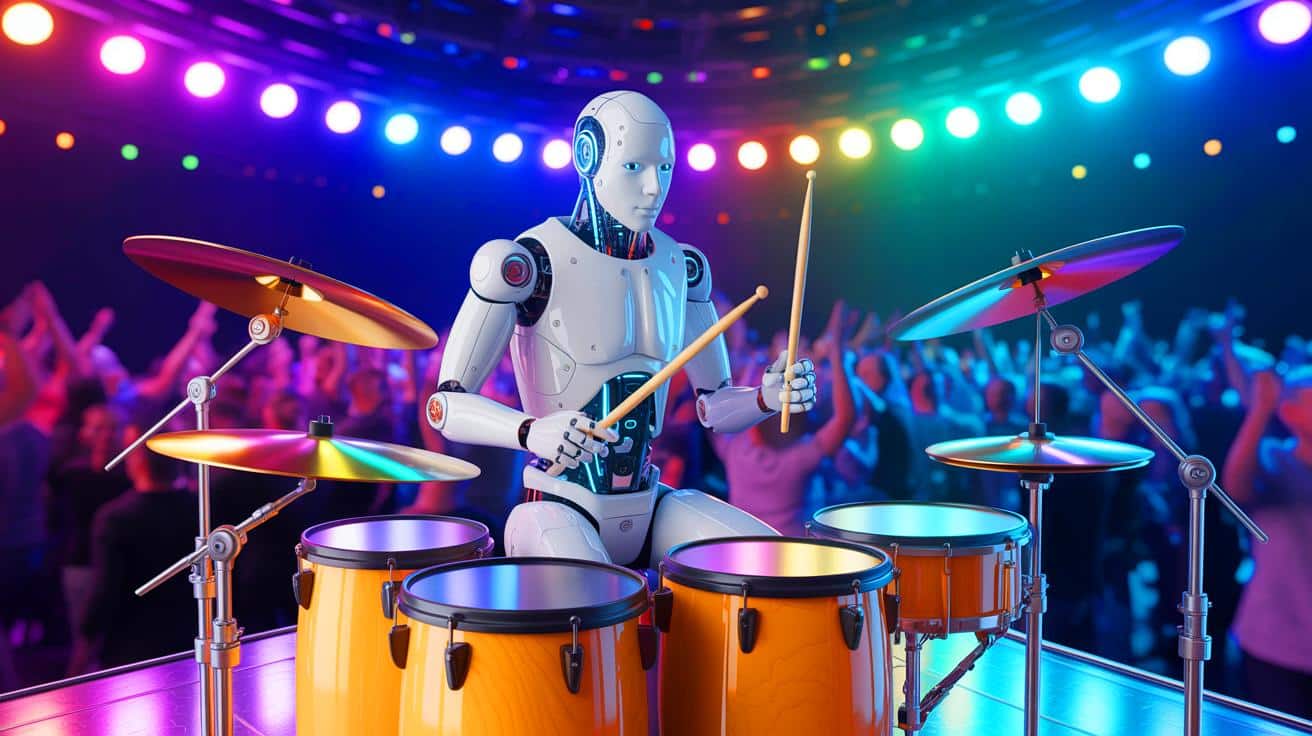
In a fascinating breakthrough for robotics and the arts, researchers have developed a humanoid robot capable of performing drum solos with remarkable precision. This innovation, which merges technology and creativity, demonstrates a humanoid robot’s potential to perform complex drum patterns with over 90% accuracy. The project, spearheaded by researchers from SUPSI, IDSIA, and Politecnico di Milano, highlights the expanding role of robots beyond industrial and caregiving tasks, suggesting a future where robots might share the stage with human musicians in live performances.
The Genesis of Robot Drummer
The idea for the Robot Drummer emerged from an unexpected source: a casual coffee chat. Asad Ali Shahid, the first author of the study, recounted to Tech Xplore how a conversation with his colleague, Loris Roveda, led to the realization that humanoid robots had yet to explore creative domains. Drumming was identified as an ideal challenge due to its requirement for rhythm, physicality, and coordination.
To bring this vision to life, the team developed a sophisticated machine learning system that enabled the G1 humanoid robot from Unitree to play entire tracks on a drum kit. The music was translated into a “rhythmic contact chain,” providing a precisely timed sequence of drum strikes. Practicing in a simulated environment, the robot honed its skills, gradually mastering the art of drumming.
Mastering Human-Like Techniques
The Robot Drummer project focused on teaching the robot human-like drumming techniques. By representing music as a sequence of precisely timed contact events, the robot learned which drum to strike and when. Over time, it developed advanced techniques such as stick switching, cross-arm hits, and optimizing movements across the drum kit.
Testing spanned various genres, from jazz to metal, with songs like “In the End” by Linkin Park and “Take Five” by Dave Brubeck. The robot achieved over 90% rhythmic precision in many tracks. Shahid noted that the robot also learned to plan for upcoming strikes and adjust its stick handling dynamically. This achievement not only paves the way for robotic performers in live music but also provides a framework for teaching precise timing skills in other fields.
Bringing the Robot to Life
With successful simulation tests, the researchers now aim to transition Robot Drummer from a virtual environment to the physical world. The next phase involves adapting the skills developed in simulation to actual hardware. Shahid expressed optimism about this transition, emphasizing that the goal is to have the robot perform in real-world settings.
Additionally, the team is working on incorporating improvisation capabilities, enabling the robot to adapt to musical cues and respond in real-time like a human drummer. If successful, this advancement could revolutionize live performances, with robots delivering flawless tempo and precision alongside human musicians.
The Future of Robotic Musicians
The potential for robots in music extends beyond perfecting rhythm and timing. As technology progresses, robotic musicians could become a staple in live performances, offering a new dimension to concerts. The ability to execute complex patterns without error presents exciting opportunities for collaboration between humans and machines.
While the primary focus is on music, the implications of precise robotic timing reach far beyond the arts. From manufacturing to healthcare, the skills developed in this project could inform future innovations. The study, published as an arXiv preprint, marks a significant step toward a future where robots and humans work together seamlessly in various domains.
As the boundary between technology and creativity continues to blur, one can’t help but wonder: how will the integration of robotic performers reshape the future of the arts, and what new possibilities will emerge as a result?