



| IN A NUTSHELL |
|
In the rapidly evolving field of quantum computing, researchers have been grappling with significant challenges related to the scalability and stability of ion traps. These traps are crucial for confining ions, which are used as qubits, the fundamental units of quantum information. Traditional planar ion traps, while scalable, often compromise on performance, while 3D traps, though stable, are bulky and difficult to integrate. A recent breakthrough at Lawrence Livermore National Laboratory (LLNL) in collaboration with the University of California offers a promising solution by leveraging advanced 3D printing techniques. This innovation could reshape how quantum computing systems are designed and optimized, potentially bridging the gap between scalability and performance.
Revolutionizing Ion Trap Design
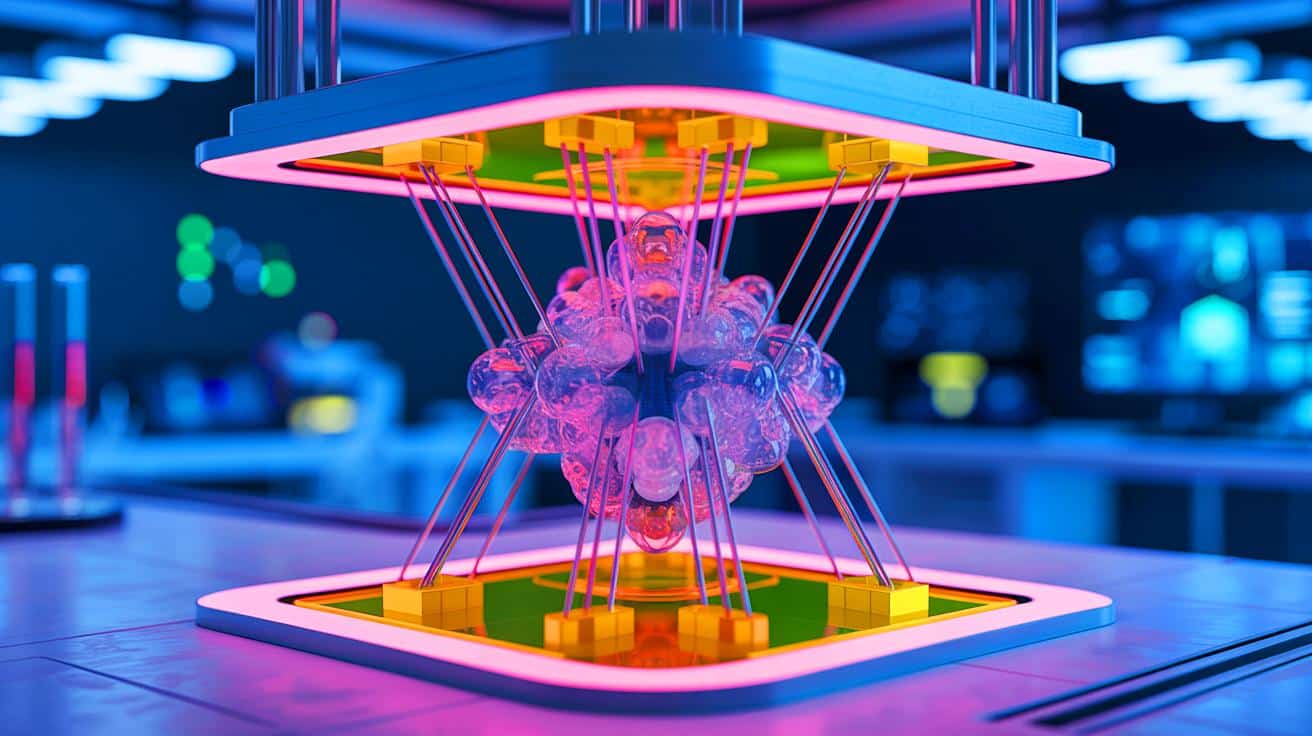
The innovation led by LLNL involves using high-resolution 3D printing to miniaturize quadrupole ion traps. These traps employ oscillating electric fields generated by four electrode poles to confine ions. By cooling the ions with lasers to their lowest energy state, they function as qubits, maintaining coherence for extended periods and operating without the need for cryogenic refrigeration. Traditionally, achieving both scalability and stability in ion traps has been a significant hurdle in quantum computing.
According to Xiaoxing Xia, a staff engineer at LLNL’s Materials Engineering Division, “3D printing gives us the confinement we need to trap the ion well and at high frequencies, and we can also make many ion traps on the same chip.” This technological leap is likened to the transition from bulky individual transistors to integrated circuits. The ability to create millimeter-scale traps with high precision allows for rapid prototyping and testing of new designs.
“Fear of Nuclear Disaster”: The US Faces Public Outcry as it Constructs Experimental Modular Reactor
Performance and Practicality
The team demonstrated the capabilities of their printed ion traps by confining calcium ions at competitive frequencies and error rates. In one experiment, two ions remained stable for several minutes while exchanging positions. The researchers also achieved a two-qubit entangling gate with a remarkable 98% fidelity, alongside performing single-qubit rotations and heating rate tests. Abhinav Parakh, a co-author and LLNL staff engineer, expressed excitement about the potential opened by this proof of concept, stating that bringing ions together, performing computations, and separating them again can now be done more efficiently.
The fabrication process itself is a major advancement, allowing a full trap to be printed in 14 hours, with electrodes taking just 30 minutes. This speed and flexibility enable rapid experimentation with new shapes and hybrid planar-3D designs. As UC Berkeley physicist Hartmut Haeffner noted, “We dramatically expanded the range of achievable trap geometries and increased the complexity,” which facilitates novel optimization strategies.
New Technique Reveals Protein Hotspots Tied to Alzheimer’s: “They Found It in 3 Key Areas”
Future Prospects and Challenges
Looking ahead, the research team aims to integrate electronics and photonics directly onto the chips, further miniaturizing quantum hardware. However, they acknowledge that noise remains a significant challenge, being the largest source of error in these systems. Kristi Beck, director of the Livermore Center for Quantum Science, indicated that reducing the material near the ions could minimize noise, potentially enhancing performance. The team is optimistic about the broader applications of their innovation, which could extend to atomic clocks, mass spectrometers, and precision sensors.
Xiaoxing Xia emphasizes the unique advantages of 3D printing for quantum computing, stating, “Quantum computing is an ideal early adopter for 3D printing because they want the very high resolution, fine features, and intricate 3D geometry that no other fabrication technique can provide.” This points to a future where 3D printing could become integral to the development of more advanced and efficient quantum systems.
Implications for the Quantum Future
This advance marks a significant step towards overcoming long-standing barriers in quantum computing. By combining the benefits of planar and 3D traps, researchers are paving the way for more robust and scalable quantum systems. The study, published in the journal Nature, underscores the potential of integrating cutting-edge fabrication techniques with quantum technology.
As the field progresses, the focus will likely shift towards addressing the remaining technical challenges, such as noise reduction and further miniaturization. The implications of these developments extend beyond quantum computing, potentially revolutionizing various technologies that rely on precise ion manipulation. The journey from innovation to application in this domain is poised to transform how we understand and utilize quantum mechanics.
As scientists continue to refine these technologies, the question remains: How will these advancements in quantum computing influence the broader technological landscape and our day-to-day lives in the coming years?