




| IN A NUTSHELL |
|
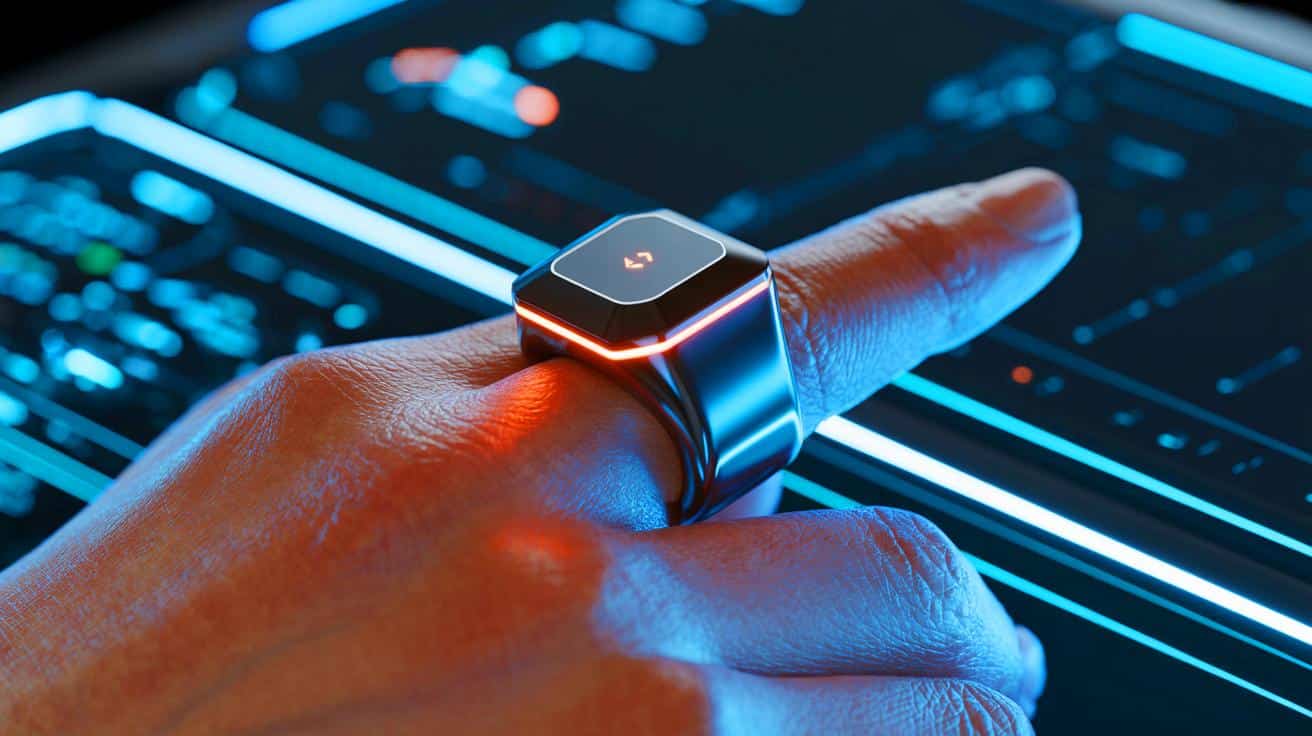
In today’s rapidly evolving technological landscape, the quest for more efficient and intuitive devices continues to drive innovation. One such breakthrough comes from researchers at the University of Tokyo, who have developed the picoRing, a tiny, ring-based wireless mouse designed to enhance control over augmented reality (AR) glasses. Weighing only 5 grams, picoRing offers a promising solution to the limitations of traditional input devices. With its ability to operate for over a month on a single charge, this innovation could redefine how we interact with digital environments.
The Need for New Input Solutions
The computer mouse has been a staple in digital interaction for decades. Its simplicity and precision have made it a difficult device to replace. However, as technology trends shift towards wearables and mobile devices, particularly in augmented and virtual reality (AR and VR), the demand for new input methods grows. Traditional mice are impractical for these environments, prompting researchers to explore alternatives.
Despite numerous attempts to innovate, many new input devices, such as gesture tracking systems and wearable rings, have faced challenges. These include issues of size, complexity, and battery life. Wearable, ring-style controllers, in particular, have struggled to balance functionality with comfort. Yet, as AR and VR headsets become more prevalent, the need for compact, desk-free input solutions becomes more pressing.
The picoRing, developed by the University of Tokyo, offers a potential answer. By addressing the power and communication challenges that have plagued previous designs, this tiny, ultralow-power ring-based mouse could make controlling AR glasses more intuitive and energy-efficient.
Innovative Engineering Behind picoRing
Project Assistant Professor Ryo Takahashi and his team at the University of Tokyo’s Department of Electrical Engineering and Information Systems have made significant strides with picoRing. Their solution involves a semi-passive communication system that drastically reduces power consumption. By consuming between 30 and 500 microwatts, picoRing can operate much longer than previous smart rings.
The key to this efficiency lies in a watchlike wristband that serves as a signal relay. This allows the ring to use far less power-hungry communications components. Traditional communication methods like Bluetooth and NFC were either too power-intensive or limited in range. To overcome this, the team developed a semi-passive inductive telemetry (semi-PIT) system. It utilizes a wire coil with distributed capacitors to naturally amplify magnetic fields, enhancing the communication range without active amplification.
While still a prototype, picoRing demonstrates the potential for more intuitive and lasting wearable technology. This innovation could pave the way for longer-lasting wearables or even serve as a base for health sensors, as Takahashi suggests.
Challenges and Limitations
Despite its promising design, picoRing is not without its shortcomings. According to Takahashi, the ring remains relatively bulky and suffers from some interference. Additionally, it can only transfer simple information, limiting its functionality to basic actions like scrolling and pressing. Complex hand gestures are not yet possible.
These limitations highlight the ongoing challenges in developing wearable input devices. However, the team is committed to overcoming these obstacles. Future improvements will focus on enhancing comfort and reliability, especially in crowded wireless environments. The wristband, currently essential for picoRing’s operation, might eventually be replaced by conductive fabrics or other wireless relays.
Such advancements could further expand picoRing’s applications beyond AR and VR, potentially making it suitable for health monitoring and other fields.
Engineer Transforms $20 Vape Pen Into Mini Web Server, But Can It Handle 1,000 Users Simultaneously?
Potential Applications and Future Prospects
The picoRing prototype, capable of running for over a month on a single charge, finds its most immediate application in AR and VR environments. Traditional mice are impractical in these settings, making picoRing a valuable alternative. However, its potential extends beyond these realms.
Project Assistant Professor Takahashi envisions further applications for picoRing technology. The ring’s close contact with the skin makes it an ideal candidate for health monitoring. It could measure physiological signals like heart rate or stress-related changes, offering valuable insights into a user’s well-being.
As research and development continue, picoRing could become a cornerstone in the evolution of wearable technology. By addressing the current limitations and exploring new applications, the team aims to unlock the full potential of this innovative device.
The picoRing represents a significant step forward in wearable technology, offering a glimpse into the future of digital interaction. As researchers continue to refine this innovation, its applications could expand across various fields. What other possibilities could the picoRing unlock in the realm of wearable technology?