



| IN A NUTSHELL |
|
The evolution of power grid technology is essential for meeting the demands of a rapidly changing energy landscape. Traditional alternating current (AC) systems have long been the standard, but direct current (DC) is emerging as a more efficient alternative, especially for renewables and data centers. However, the limitations of outdated circuit breakers pose significant challenges for DC adoption. Researchers at Oak Ridge National Laboratory (ORNL) have made a breakthrough with semiconductor-based circuit breakers that promise to overcome these hurdles. This innovation is set to transform energy distribution, paving the way for more resilient and efficient power systems.
Revolutionizing Circuit Breaker Technology
The U.S. power grid faces mounting pressure from increasing energy demands and the integration of renewable sources. Traditional mechanical circuit breakers, which are adept at handling AC’s alternating flow, fall short when applied to DC systems. This is largely due to DC’s continuous one-way flow, which lacks a natural “zero point” that mechanical breakers rely on to interrupt current safely. The delay in interruption can lead to heat accumulation and increased fire risks.
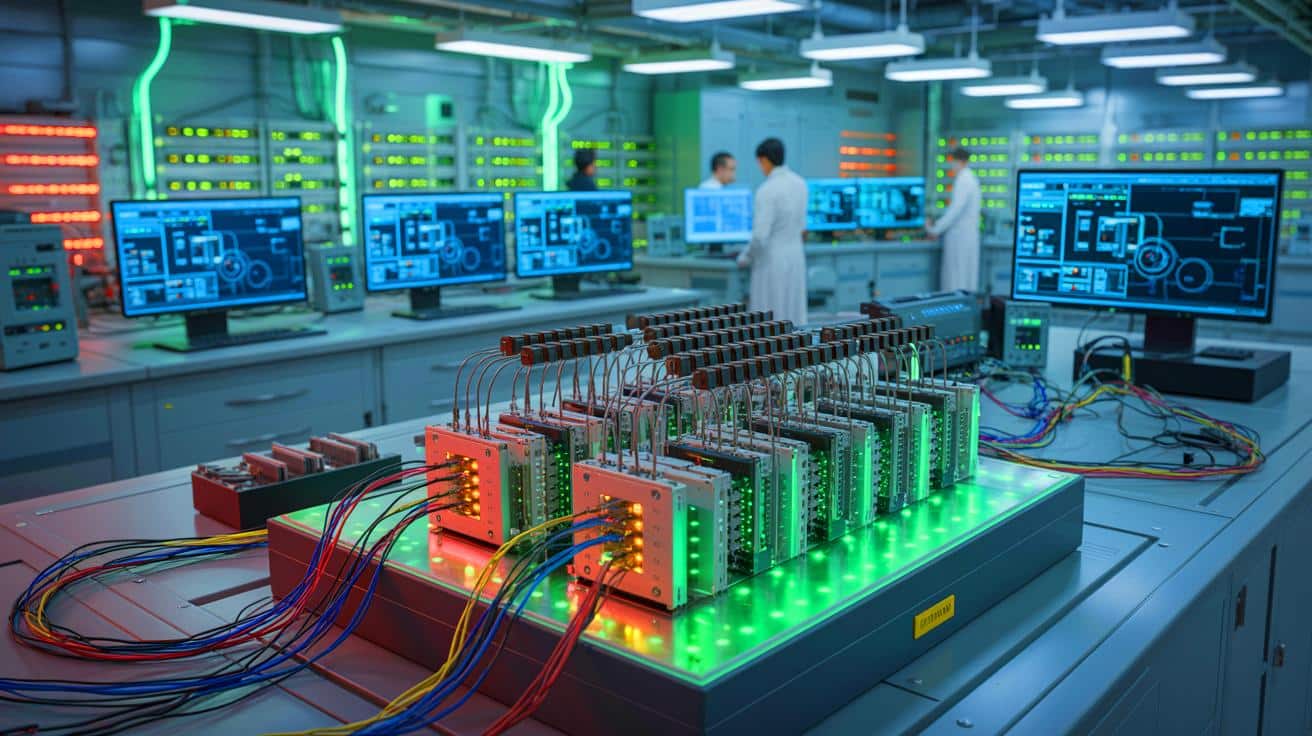
To address this, ORNL engineers have developed semiconductor-based, medium-voltage circuit breakers specifically designed for DC systems. These breakers are engineered to react up to a hundred times faster than their mechanical counterparts, significantly reducing the risk of arcing and enhancing safety. By utilizing thyristors, an older yet reliable semiconductor, the team has crafted a prototype capable of interrupting 1,400 volts in under 50 microseconds. This innovation marks a pivotal advancement in circuit breaker technology.
Overcoming Technical Challenges
The development of these advanced circuit breakers was not without its challenges. Scaling the system for practical, real-world applications required connecting multiple units in series, a process fraught with technical difficulties. Engineers had to ensure that voltage was evenly distributed across all breakers while maintaining rapid response times during faults.
The ORNL team successfully addressed these challenges, testing the breaker at voltages up to 1,800 volts. Future efforts are focused on reaching 10,000 volts, a crucial benchmark for high-demand DC grids. Until now, no commercial breaker could safely handle over 2,000 volts of DC, highlighting the significance of ORNL’s breakthrough. This development is especially critical for sectors like AI data centers and advanced manufacturing, which heavily rely on DC-based power electronics.
The Benefits of DC Systems
Direct current systems offer several advantages over their AC counterparts, making them an attractive option for modern power grids. DC systems experience fewer line losses and support cheaper transmission, contributing to more efficient energy distribution. Furthermore, they enable multi-directional energy flow, which is vital for a flexible and resilient grid.
In industries such as advanced manufacturing and data centers, the reliance on DC-based power electronics is growing. These systems lose efficiency when forced to convert to AC, a problem that ORNL’s semiconductor-based circuit breakers help alleviate. By eliminating the arcing risks associated with mechanical breakers, these innovations ensure safer and more reliable DC power delivery.
Future Implications and Research Support
ORNL’s work in developing modular, medium-voltage hardware is part of a broader strategy to meet the future needs of the U.S. power grid. The implications of this research extend beyond energy distribution, impacting sectors such as transportation, manufacturing, and large-scale computing. The project is funded by the DOE Office of Electricity and receives support from engineers Marcio Kimpara and Elvey Andrade.
“Developing this technology helps keep the grid working safely and reliably while keeping more energy available to support our growing population and economy,” stated Prasad Kandula, who leads the project at ORNL.
As advancements in DC technology continue, they promise to play a crucial role in shaping the future of energy systems, supporting a more sustainable and efficient power infrastructure.
The strides made by ORNL in semiconductor-based circuit breaker technology represent a significant step forward in modernizing power grids. By enhancing the safety and efficiency of DC systems, these innovations pave the way for a more resilient energy future. As researchers aim to reach new voltage benchmarks, the potential applications of these breakthroughs continue to expand. How might these advancements reshape our approach to energy distribution and consumption in the years to come?