



| IN A NUTSHELL |
|
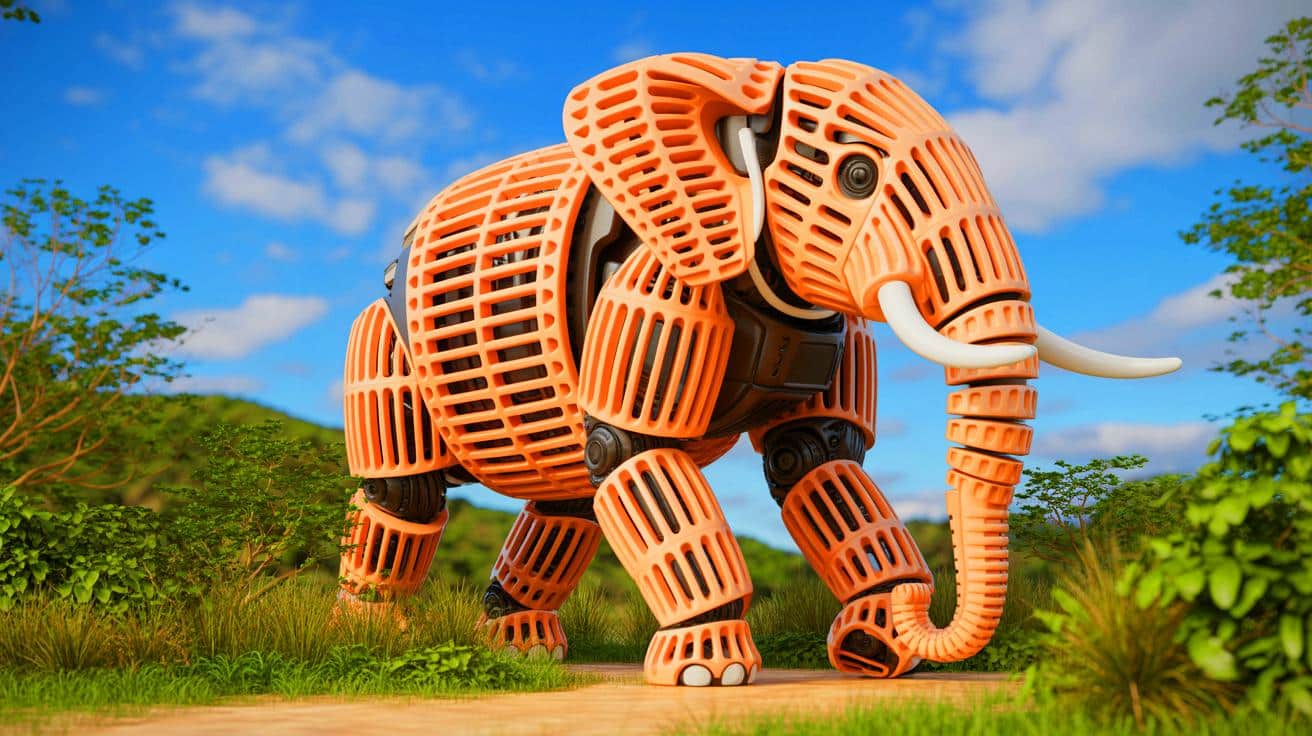
In a captivating leap forward for robotics, scientists have unveiled a groundbreaking development that merges biology with technology. A team at EPFL has crafted a unique foam lattice that allows robots to bend, twist, and bear weight in ways that closely mimic animal movement. This innovation promises to revolutionize the field by offering machines unprecedented adaptability and precision. The centerpiece of this advancement is an elephant-inspired robot, equipped with a flexible trunk and articulated limbs, showcasing the potential of this new technology.
Programmable Foam With Muscle-Like Range
The innovative foam lattice, developed by EPFL’s Computational Robot Design and Fabrication Lab (CREATE) under the guidance of researcher Josie Hughes, is at the heart of this advancement. It employs a programmable structure composed of individual foam “cells” that can assume various shapes and orientations. These cells form the core of the robot’s mechanical capabilities, allowing for a dynamic range of motion.
Qinghua Guan, a postdoctoral researcher, explained, “We used our programmable lattice technique to build a musculoskeletal-inspired elephant robot with a soft trunk that can twist, bend, and rotate, as well as more rigid hip, knee, and foot joints.” This capability is achieved through two primary cell types: body-centered cubic (BCC) and X-cube, each offering distinct stiffness and deformation properties. The true breakthrough, however, lies in the ability to blend these cells seamlessly, mimicking the gradual transition from muscle to tendon and bone found in animals.
Infinite Cell Configurations
The versatility of this technology is further enhanced by the ability to rotate, shift, or superimpose the cells along different axes, introducing a second programming dimension. Such control unlocks a multitude of geometric combinations, allowing researchers to design highly complex robotic joints. For instance, a single lattice cube with four superimposed cells can generate approximately four million configurations, and with five cells, the possibilities multiply to over 75 million.
This flexibility enables the creation of various joint types in the robotic elephant, including a sliding joint for foot bones, a bending joint for the knee, and a complex biaxial joint for toe movement. Separate lattice zones facilitate trunk movements like bending, twisting, and rotating, ensuring smooth transitions between each section. This innovative approach opens up new avenues for integrating materials and achieving fluid motion in robotics.
Applications Beyond Locomotion
The foam lattice’s unique properties offer potential far beyond simple movement. As Josie Hughes notes, “Like honeycomb, the strength-to-weight ratio of the lattice can be very high, enabling very lightweight and efficient robots.” The open foam structure is particularly suitable for fluid motion, with the potential to integrate additional materials such as sensors, enhancing the intelligence of robotic systems.
This technological breakthrough paves the way for future robots that are not only soft-rigid but also possess built-in intelligence, motion range, and structural diversity, all arising from a customizable foam skeleton. The study detailing these advancements is published in Science Advances, reflecting a significant step forward in the field of robotics.
Future Implications
The implications of this research are vast, extending beyond the immediate applications in robotics. By mimicking the intricate structures of living organisms, this technology could inspire innovations in various sectors, including healthcare, aerospace, and environmental monitoring. The ability to create lightweight, adaptable structures could lead to breakthroughs in prosthetics, allowing for more natural and responsive artificial limbs.
As the boundaries between biology and technology continue to blur, the potential for creating machines that can seamlessly interact with the world around them grows ever closer. This advancement raises intriguing questions about the future of robotics and the role such technologies will play in our everyday lives. How will this newfound adaptability and intelligence in machines shape the way we live and work in the years to come?