



| IN A NUTSHELL |
|
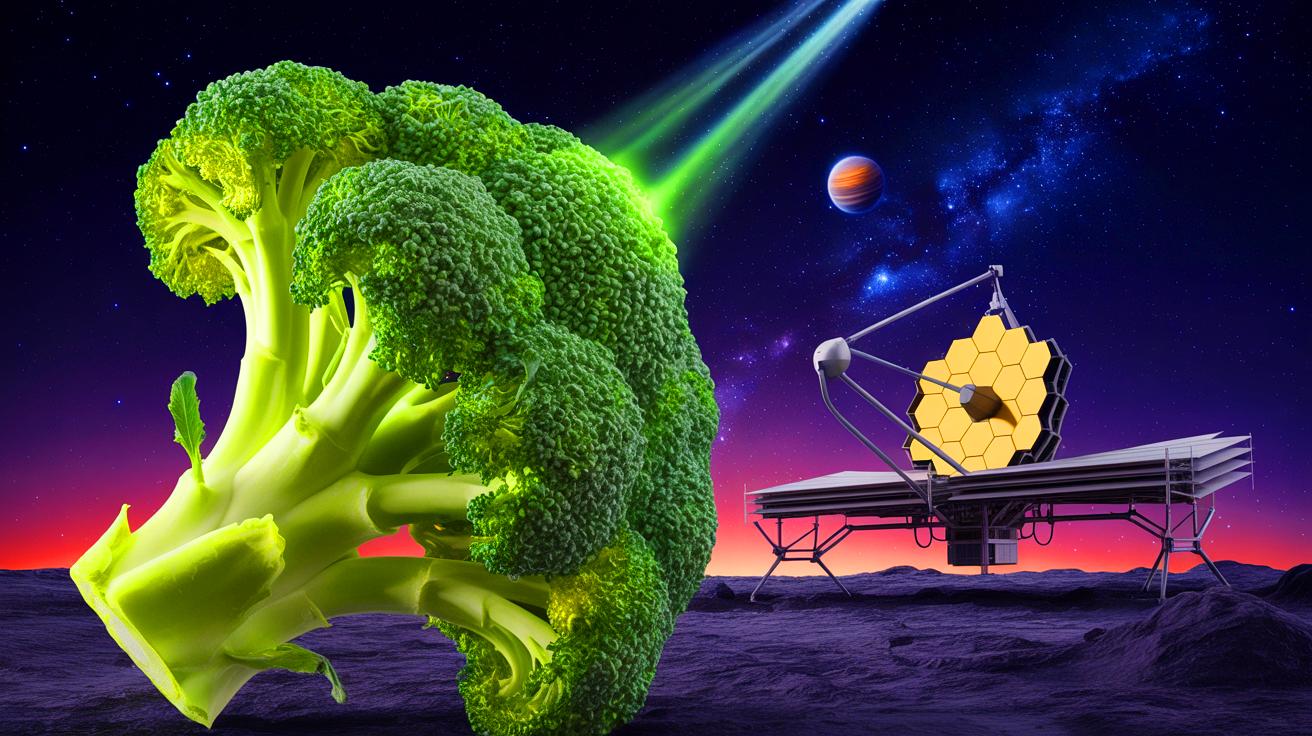
What if the gas released by broccoli could play a crucial role in the search for extraterrestrial life? In a fascinating twist, researchers from the University of California, Riverside, have suggested that the methylated gases emitted by broccoli might be an indicator of life on other planets. This finding adds a new dimension to the ongoing quest to discover life beyond Earth, leveraging the unique properties of a common vegetable. By examining the gases that vegetables like broccoli emit, scientists hope to identify biosignatures in the atmospheres of distant exoplanets. This innovative approach could potentially revolutionize the methods used to detect alien life.
Detectable Atmospheric Gas Particles
The search for extraterrestrial life has taken a significant step forward with the identification of new possible biosignatures. In 2021, Massachusetts Institute of Technology (MIT) researchers proposed that the detection of isoprene in the atmosphere of an exoplanet could indicate life. However, the recent study from the University of California highlights the potential role of methylated gases from broccoli as a simpler, yet effective, marker of life.
Plants, algae, and microbes undergo a process called methylation, transforming toxins into detectable gases. These gases, including those emitted by broccoli, are visible in the mid-infrared spectrum. This visibility is crucial for instruments like the James Webb Space Telescope, which can identify atmospheric gas particles when a planet passes near its star. The research suggests that if such gases are detected in an exoplanet’s atmosphere, it may point to the presence of living organisms.
A Method Requiring Great Patience
The focus of the study is on methyl bromide (CH3Br), a gas with short persistence in the atmosphere. Its presence in a planet’s atmosphere could strongly suggest active biological processes. However, detecting this gas is no easy feat due to the environmental conditions of distant planets. The UV rays emitted by stars like our Sun and red dwarf stars break down water molecules, which accelerates the decomposition of gases like methyl bromide.
Consequently, scientists must observe numerous transits of a planet before detecting these potential biosignatures. Despite these challenges, researchers remain hopeful because methylation is a process believed to be universal among life forms. Nonetheless, they must also consider non-living sources, such as volcanic eruptions, which can emit similar gases. While the potential for false positives exists, the method remains promising for identifying life beyond Earth.
The Implications of Methylated Gases
Discovering biosignatures like methylated gases could have profound implications for our understanding of life in the universe. The ability to detect these gases in the atmospheres of exoplanets may provide the evidence needed to confirm the existence of extraterrestrial life. This marks a significant advancement beyond traditional methods that have focused primarily on the presence of water or oxygen.
The study underscores the importance of taking innovative approaches in the search for life. By considering unlikely sources such as vegetables, scientists are expanding the scope of what is possible in astrobiology. This research not only broadens the search parameters but also encourages a reconsideration of what constitutes a biosignature. It paves the way for future studies to explore unconventional indicators of life.
The Role of Advanced Technology
The James Webb Space Telescope plays a pivotal role in the search for biosignatures like methylated gases. Its advanced capabilities allow it to detect minute changes in the composition of a planet’s atmosphere, offering a window into the potential for life. As technology continues to advance, the precision and accuracy of these observations will improve, increasing the likelihood of detecting extraterrestrial life.
While the challenges are significant, the potential rewards are immense. The ability to confirm life on another planet would be a paradigm-shattering discovery, reshaping our understanding of biology, evolution, and our place in the cosmos. As researchers continue their meticulous work, the scientific community and the public alike watch with anticipation.
The search for extraterrestrial life is an endeavor that combines patience, innovation, and cutting-edge technology. With each new study, we inch closer to answering one of humanity’s most profound questions: Are we alone in the universe? As researchers explore unconventional methods such as methylated gases emitted by broccoli, the potential for groundbreaking discoveries grows. What other surprising sources might contribute to our quest for understanding life beyond Earth?