




| IN A NUTSHELL |
|
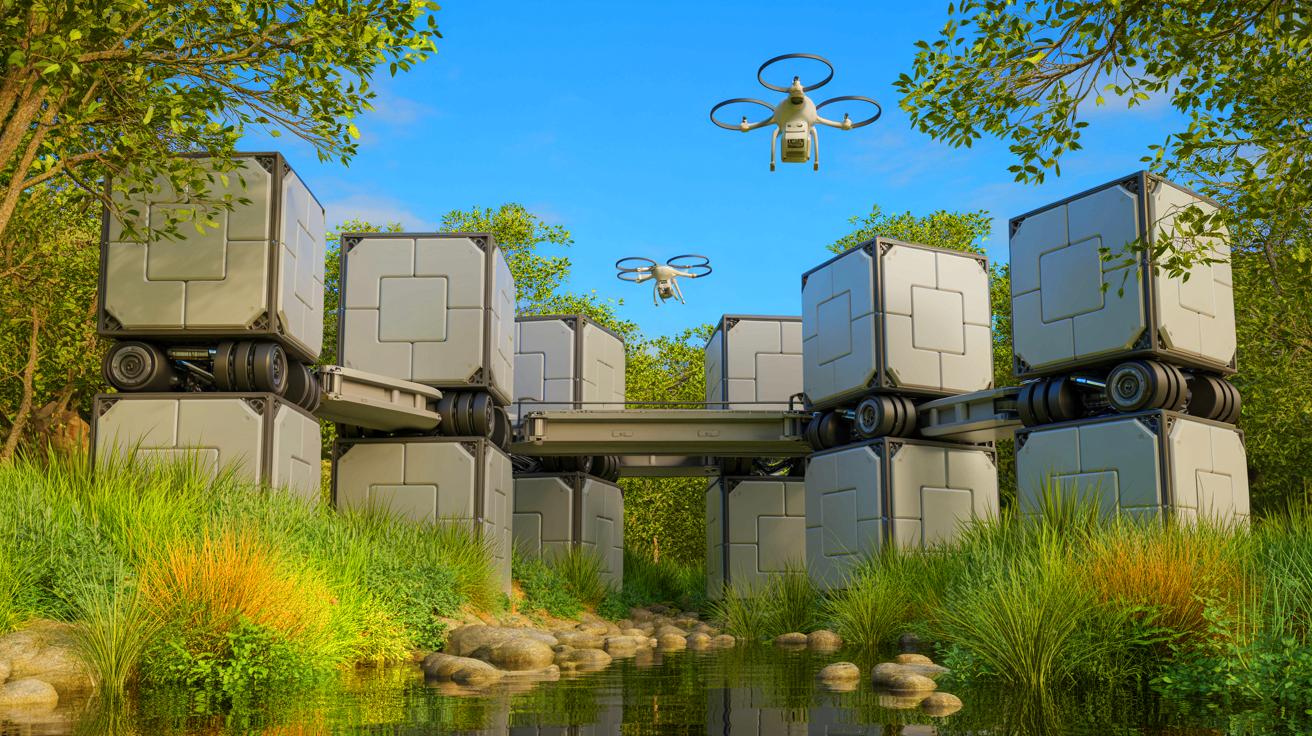
In recent years, the development of modular robots has captured the attention of researchers and tech enthusiasts alike. These robots, comprised of cube-shaped blocks, have demonstrated an impressive capacity to adapt to their environment and perform a variety of tasks. A team at Dartmouth College recently showcased the potential of these robots in outdoor settings, where they navigated complex terrain, assembled into structures, and even participated in rescue simulations. This advancement highlights a significant step forward in robotic technology, offering promising applications in fields such as emergency response and construction.
Innovative Modular Design
The modular robots developed by Dartmouth researchers are built from cube-shaped blocks that integrate both rigid and flexible components. This design allows the robots to adjust their shape and move in response to environmental challenges. According to Luyang Zhao, a key member of the research team, the versatility of these robots lies in their ability to be configured in multiple ways, much like how ants form chains to bridge gaps.
The robots were tested in real-world conditions, where they demonstrated their capability to crawl under logs and squeeze through tight spaces. This adaptability is further enhanced by the use of drones, which assist in constructing taller structures by overcoming gravitational constraints. The integration of drones into the system allows for a wider range of applications, potentially transforming the way these robots are used in practical scenarios.
Potential for Emergency Response
One of the most promising applications of modular robots is in emergency response situations. Their lightweight and deployable nature make them ideal for rapid deployment in disaster-stricken areas. Zhao notes that these robots can be airdropped into remote locations and quickly assembled into functional structures such as bridges or temporary shelters.
The robots have already been used to create a stretcher capable of carrying a human dummy, although they are not yet equipped to transport live humans. This limitation is an area of focus for future research, with the aim of increasing the robots’ weight-bearing capacity. The ability to quickly assemble and disassemble structures could prove invaluable in search and rescue operations, where time is of the essence.
Tesla’s $329 Million Autopilot Crash Verdict Sparks Outrage: “The System Failed My Family”
Technical Specifications and Capabilities
The technical design of the modular robots is both innovative and practical. Each block features a 3D-printed center with eight extending rods, a battery, and a Wi-Fi module for untethered operation. The blocks are capable of autonomous movement, operating for over three hours on a single charge.
Motors located on the end-caps of each block adjust the tension of internal strings, allowing the robots to change shape and connect with other blocks. This mechanism enables a significant range of motion through small deformations, demonstrating the efficiency of the design. The combination of structure and movement in these units exemplifies the potential of modular robotics in various applications.
Future Directions and Challenges
As modular robotics technology continues to evolve, researchers are focusing on enhancing the capabilities of these systems. The next steps involve increasing the weight capacity of the robots and incorporating sensors to enable greater autonomy. By doing so, the robots could perform more complex tasks without human intervention.
Zhao, now an assistant professor at Clemson University, emphasizes the importance of these developments for the future of robotics. The potential to reconfigure and adapt these robots for different tasks could revolutionize industries such as construction and disaster management. However, significant challenges remain, including improving the robots’ durability and ensuring their safe operation in diverse environments.
The advancements in modular robotics at Dartmouth College have showcased the immense potential of these systems in real-world applications. As researchers continue to refine and expand the capabilities of these robots, the question remains: how will these innovations redefine our approach to problem-solving in complex environments?