

British Broadcasting and Regulation
 By
Callum Fairbairn
By
Callum Fairbairn
Rough draft of data collected from a number of sources – this page not complete.
Interest here is how British Governments have regulated radio from the outset.
1874 – Guglielmo Marconi born on 25th April in Bologna.
1895 – The first wireless transmissions at Villa Griffone, Bologna.
1896 – Marconi comes to London in February to exploit his invention. The British patent number 12039 is filed on the 2nd June.
1897 – The Wireless Telegraph and Signal Company is registered on the 20th July.
1899 – The Hall Street Works, Chelmsford is acquired by the Wireless Telegraph and Signal Company to become the first radio factory in the world.
1899 – Marconi achieving ranges of sixty miles. His equipment used for ship to shore communication.
1901 – The famous ‘7777’ patent granted allowing simultaneous broadcasts on different frequencies. Company name changed to Marconi’s Wireless Telegraph Company. The Marconi International Marine Communication Company Ltd. formed.
1902 – Pouson developed the arc transmitter.
1906 – R.A. Fessenden, USA, transmitted speech over several hundred miles.
1909 – Nobel prize for Physics awarded to Guglielmo Marconi and Karl Ferdinand Braun “in recognition of their contribution to the development of wireless telegraphy”.
1910 – Arrest of the infamous Dr. Crippen and his mistress following a wireless message from S.S. Montrose to New Scotland Yard.
1912 – Wireless distress calls from the Titanic save 705 lives.
1913 – German wireless station in Nauen transmitted morse 1550 miles.
1914 – Marconi Company start experimental speech transmissions from Marconi House London.
1915 – American Telephone and Telegraph Co. with Western Electric sent speech fron The Naval station in Arlington to The Eiffel Tower.
1918 – The Marconi Co. start experimental speech transmissions from Iceland to North America.
1919 – Marconi buys yacht Elettra as a floating laboratory.
1919 – The Armed Forces put pressure on the Post Office to ban further broadcasts until the Government could think up ways of regulating it.
1920s – 250,000 amateur radio enthusists in the early 1920s – annual licence fee imposed upon them by the British Government.
1920s – In the twenties, Marconi’s Managing Director, Godfrey Isaacs became embroiled in what was to become known as the Marconi Scandal. A Select Committee had to be set up to investigate the serious allegations of insider dealing between himself; his brother Isaac Rufus (who was then Attorney General); the Postmaster General, Herbert Samuel and the Prime Minister, Lloyd George. Licences were eventually issued by the Government allowing stations to broadcast just 15 minutes a week.
1920 – The first advertised public broadcast programme. A song recital by Dame Nellie Melba is broadcast from the Marconi works in Chelmsford.
1920 – Start of twice daily experimental programmes from Chelmsford.
23 February 1920 – Broadcasting tests start from The Marconi Company in Chemlsford.
22 Jun 1920 – Dame Nellie Melba sings from Chelmsford.
1921 – Regular programmes start from The Strand. Other stations set up in Birmingham and Manchester.
1922 – Broadcasts commence from Marconi House in London (2LO) and The British Broadcasting Company (BBC) is formed by Marconi and five other companies.
1922 – First broadcast made from a wooden hut at Writtle near Chlemsford by Peter Eskersley (1892 – 1963). Ceased broadcasting on 17 January 1923.
1922 14 Feb – 1st broadcast from Marconi station 2MT at Writtle.
11 May 1922 – 1st broadcast from Marconi station 2LO LONDON.
16 May – 1st broadcast Metropolitan Vickers 2ZY Manchester.
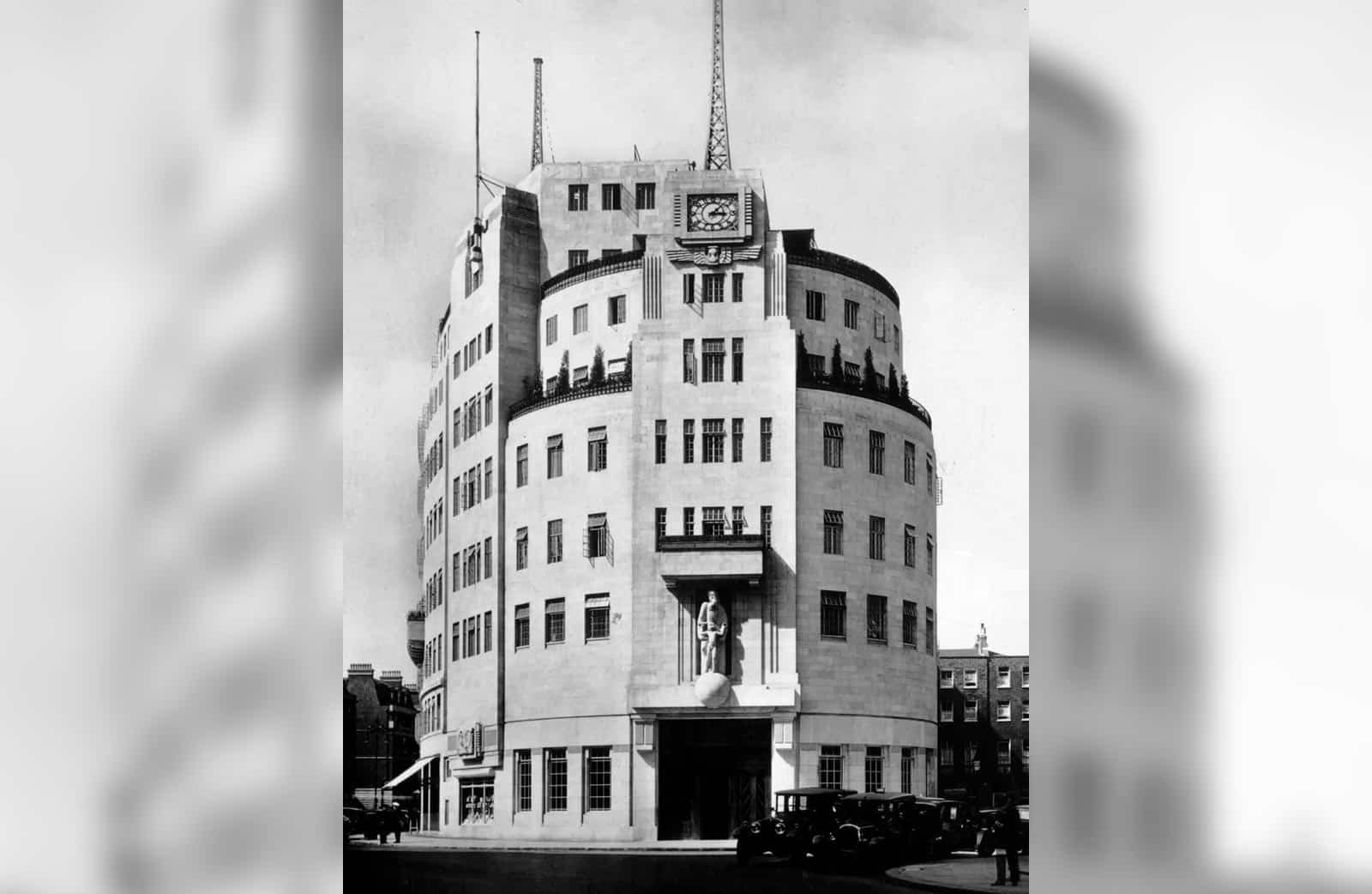
18 October 1922 – Government decides to let only one company to broadcast – the British Broadcasting Company. In July 1922, one of these new stations broadcast some rather trivial local news of a garden fete. The press were quick to respond, calling it: “unconsidered trifles of the lightest type,” so the Conservative Government resumed responsibility for broadcasting and formed the British Broadcasting Company Limited under the directorship of a rather dour Scotsman called John Reith. Sculptor Eric Gill was commissioned to work on a statue of Ariel, now posing above the doorway of Broadcasting House.
1 Nov – Broadcast Receiving Licence started. 10 shillings per year. BBC given monopoly status for public radio transmissions.
14 Nov – The British Broadcasting Company first station 2LO opened.
2LO London, 5IT Birmingham, 2ZY Manchester.
24 December 1922 – 5NO Newcastle
13 February 1923 – 5WA Cardiff
6 March 1923 – 5SC Glasgow
10 October 1923 – 2BD Aberdeen
17 October 1923 – 6BM Bournemouth
21 July 1924 – 5XX tests on Long Wave.
1925 Radio Paris. First commercial broadcast from the Eiffel Tower in English by Captain L.F. Plugge.
31 December 1926 – Government decides to control all broadcasting. British Broadcasting Corporation formed. In 1926, 16 participating European countries, including Britain, sat at the first conference on radio in Geneva and carved up the airwaves between them.
Before Radio Luxembourg, Captain Plugge toured France with the very first car radio manufactured by Philco and beamed music from Radio Normandy to Britain after midnight. ‘Auntie’was not amused. Even less so when she heard the French government was behind the 200 kilowatts of dance music pumping out from Luxembourg to England every night. The Postmaster General wrote to the Head of the BBC saying: “We must use all our influence to stop this.” In an internal memo of 7th April 1933, the BBC suggested persuading leading newspapers not to refer to it. It went on to say: “It seems to me that a possible way of combating Luxembourg would be to allot the wavelength to somebody else, not as their only wavelength, but to get someone with a sporting spirit to take it on and try and clear the channel.”
1928 – Hilversum broadcasts Sunday concerts.
1929 – Radio Toulosse in English until 1931.
October 1931 – International Broadcasting Company starts transmissions over Radio Normandie.
May 1932 – Radio Luxembourg – 1250 metres tests.
Spring 1933 – Radio Luxembourg starts transmissions.
The British Government monitored Radio Luxembourg from its listening post at Tatsfield, compiled a list of foreign stations they claimed might be experiencing interference, and demanded Luxembourg accepted a frequency more befitting the size of the country. Luxembourg refused. The Government then successfully persuaded the Newspaper Publisher’s Association to completely censor any information connected with Radio Luxembourg.
By now, any artistes who worked for Radio Luxembourg were blacked by the BBC while its own announcers spoke in punctilious statements between records and women addressed the microphones in ball gowns.
1937 – Guglielmo Marconi dies in Rome on 20th July. The Company starts Government orders for ‘Chain Home’ stations, Britain’s first air defence radar network.
1939 – All overseas broadcasts stop except Radio International from Normandie. Closed in 1940.
During the war, Radio Luxembourg was used as a propaganda station by the occupying German fascists. In 1944, a special American task force under the direction of the Psychological Warfare Division liberated the station and silenced Lord Haw-Haw’s (alias William Joyce’s) infamous voice. He was later hanged for treason.
1945 – Of the continetnal broadcasts to Britain, only Radio Luxembourg recommenced broadcasting.
1950s During the fifties, the 500 or so new records released each week in Britain could only be aired on the BBC Light Programme’s ‘Mid-day Spin’, Sunday’s ‘Family Favourites’or the daily ‘Housewives’Choice.’
1960
In 1960, Macmillan’s Conservative Government set up the Pilkington Committee to discuss local radio of which they found “no evidence of public demand”. However they did recommend a trial, but the Government resisted in its White Paper of July 1962 saying that they “would prefer to take cognisance of public reactions before reaching a decision”. (A little difficult considering the last time the public had heard local radio was before the Home Service was set up at the outset of World WarII)!
The very first European offshore free radio station – one of a handful, off Scandinavia – was Radio Mercur, broadcasting off Denmark in 1958. The Scandinavian Governments put their heads together to enact their own anti-‘pirate’legislation on August 1st, 1962. Radio Syd, however, continued and resulted in the imprisonment, in Sweden, of the station’s owner, Ms Britt Wadner.
The Scandanavians benefited by the arrival of Radio Scotland whose broadcasts reached then from off the coast at Dunbar on 242 metres from the MV Comet on New Year’s Eve 1965 before it sailed round the coast to broadcast off Troon.
In 1964, channel tracking stations watched as several new radio stations set themselves up around the British coast. One of them was Radio Caroline, carrying Britain’s popular DJ: Kenny Everitt.
Then Postmaster General, Reginald Bevins, declared that Radio Caroline was causing interference to a Belgian station concerned with communications to ships at sea and that she was interfering with British Maritime Services. A former BBC radio engineer reported back in theaily Mail that Radio Caroline was broadcasting nowhere near the maritime wavelengths.
The Post Office cut off the ship-to-shore service and permitted its use for maritime emergency use only. They then set about warning the general public that they would be liable for prosecution under the Wireless Telegraphy Act of 1949 if they even so much as listened to the stations!
British Customs and Excise Officials sent out the Venturous in an attempt to board Radio Caroline to see her bonded stores. After it was pointed out to them that the ship was in international waters they steamed away. HM Customs and Excise ruled that passports had to be carried by all persons on board tenders going out to the ships. HM Waterguard, HM Immigration. Special Branch, CID, Board of Trade, Ministry of Transport, British Railways, the Port of Health Authority, Trinity House and the Local Harbour Board continued to make regular inspections and Caroline House in Chesterfield Gardens was forbidden an entry in the GPO telephone directory.
It was reported that less than 1% didn’t support the stations. The Daily Telegraph reported that “Radio Caroline has a bigger afternoon audience in the areas that it covers than all the BBC programmes put together.” The Labour Government was determined to ignore public opinion, but with such a slim majority they couldn’t risk taking any action at this stage. Conservative backbenchers, however, were making maximum capital out of the situation, openly supporting the free radio stations.
The sudden introduction of The Continental Shelf Act in September 1964 extended UK territorial waters to include the continental shelf and putpaid to stations like Radio Sutch and 390 broadcasting from old sea forts whose structures rested on it. Ships would not be affected by this act since they were afloat and outside the three-mile limit. Talk by some of the free radio stations of moving to the only fort outside this new limit was thwarted at the last minute. The Government had it blown up.
21-year old Jean Ollis appeared in a series of BBC advertisements that read: “People like me like the BBC Third Programme”, (the forerunner of Radio Three). After payment she was happy to announce that she in fact listened to Radio Caroline.
Radio Caroline attempted to put its case backed by a team of independent radio experts but were unable to gain any time on BBC radio or television to do so. Phonographic Performance Limited and the Musicians’ Union also refused to discuss the matter with them. Radio Caroline was particularly eager to point out that prior to its broadcasts just four companies owned 100% of record sales. The free radio stations had been successful in whittling that down to 80% in just three years. All the leading stations continued to pay money to the Performing Rights Society and were regularly bombarded by performers and promoters, eager to have their material broadcast.
In 1967, after just three years of opening, the National Opinion Polls announced Radio Caroline had the greatest weekly audience of any commercial station in the world.
The Labour Government under Harold Wilson did its best to avoid free radio becoming an election issue until they had a bigger majority in the House: which they did in 1966. Then, the Postmaster General, Tony Benn, prepared the case against free radio. He argued that they stole wavelengths; paid no copyright on the records played; were a hazard to shipping as they interfered with ship-to-shore communication; flouted international regulations and gave the country a bad name abroad. The Government went on to cite 12 European countries registering complaints of interference with their own authorised broadcasts. They were all signatories of the Strasbourg Treaty.
At one minute past midnight on 15th August 1967 the Marine Offences etc bill became an Act of Parliament and one by one, the offshore free radio stations closed down.
28 March 1964 – Radio Caroline from International Waters off Felixstowe.
9 May 1964 – Radio Atlanta starts.
27 May 1964 – Screeming Lord Sutch starts transmissions from the Shivering Sands Fort.
24 June 1964 – Jeremy Thorpe – “A radio station could easily be inflamatory, seditious, obscene or undesirable, with no protection to the public.”
14 August 1967 – Marine Broadcast Offences Act introduced.
1970s After the Marine Offences Act, young listeners were left at the mercy of BBC ‘ Wonderful’ Radio One. Records were selected by a panel of five producers headed by a woman in her fifties and by the end of 1973. Edward Heath’s Government was establishing local commercial radio stations licensed by the Independent Broadcasting Authority, (IBA). The Director General was appointed by the Prime Minister, and the 11 Government Appointees selected from a Civil Service list. The IBA stations pressed ahead with their expansion across the country, imposing themselves upon the listening public in varying degrees of awfulness. By 1970. the Dutch free radio station, Radio Veronica was Joined by a new Dutch neighbour: Radio North Sea International. On FM, Medium Wave and Short Wave, RNI – like the BBC World Service – could be heard world-wide from its transmitters on the MV Mebo II, anchored in international waters.
The British Government ordered jamming of the transmissions; something no western nation had ever done since the war. In 1973, Billboard’s top selling pop newspaper, Record Mirror, were stunned by the results of their survey which saw BBC Radio One collect less than 5% of votes for best radio station! Radio North Sea International, Radio Caroline and even the Dutch service of Radio Veronica were voted better in the poll. European Governments abiding by the terms of the Strasbourg Treaty put heavy pressure on Holland to close the stations. At midnight on August 31st, 1974, minister Harry van Doorn successfully introduced legislation to close the stations.
All but one ship stayed at sea to broadcast. Whilst Radio Caroline broadcast album music in the evening, another entrepreneur, Sylvan Tack, the manufacturer of ‘Suzy’ waffles In Belgium, broadcast the Dutch language programmes of Radio Mi Amigo from the MV Mi Amigo 18 miles from the English coast. Radio Mi Amigo broke a virtual American monopoly an imported music to Britain. In 1975 the Belgium police carried out raids in search of the offices of Radio Mi Amigo but Sylvan Tack had moved all the operations to Playa de Aro in Spain, a country not yet a signatory of the Strasbourg Convention. The British Government assisted the Belgians by making frequent raids on any boat tendering the MV Mi Amigo from Britain. Of those tenders making the Journey from Spain, they were escorted by two Police launches, a Naval Patrol Boat and a helicopter. A fishing boat, anchored half a mile from the ship was staffed by British Government officials and photographers.
Whilst the Government were monitoring Radios Caroline and Mi Amigo from their listening post, more sinister developments were taking place on land. On January 11th, 1979, the police and a Home Office official raided the home of Derek McCauney, a medical student, without a search warrant. A model boat bearing the name Mi Amigo was found and McCauney was arrested and charged with advertising a ‘pirate’radio station. He had been making a number of these boats to sell at a benefit dance in aid of a children’s hospital. About the same time, the printers of the Caroline Newsletter, Southline Printers, producing a hand-typed newsheet for free radio enthusiasts campaigning for a review of Clause 5.3 (f) of the Marine Offences Act, had pressure put on them by representatives from Scotland Yard to stop printing and Michael Brigden and Carolyn Oakley appeared in court facing 24 charges under the Marine Offences Act for offering for sale various souvenirs of Radio Caroline in their magazine. Geoffrey Baldwin. the founder of the Caroline Movement was also visited by Scotland Yard. He had the facilities of a PO Box address used by the Caroline Movement withdrawn and was also warned that he might face prosecution.
In April 1975, free radio supporter Jackson Hunter was convicted after refusing to pay his fine in Liverpool Magistrate’s Court and subsequently imprisoned for 60 days for displaying a Radio Caroline car-sticker! David Hutson was also convicted and fined for selling badges bearing the words: ‘Radio Caroline’. LASER 558 On January 19th 1984, a new free radio station took up anchor close to Radio Caroline: Laser 558.
With American backing, Laser 558 began broadcasting from the MV Communicator anchored 14 miles off the Essex coast and quickly became very popular as the first station to use women deejays. With its claimed audience of 8 million listeners, mostly in southern England, it was seriously threatening the BBC/IBA duopoly on radio broadcasting whose listeners were deserting then in droves for the brash, new American station. The American Government was asked for their assistance in identifying the stations financial backers and Lord Thomson of the IBA accused the Government of ‘apparently condoning theft’ of the airwaves for not acting more firmly against Laser. Both Vatican Radio and Voice of America are amongst many stations that have not been ‘allocated’wavelengths. The USA boarded their only free radio station after just 4 days of broadcasting yet regularly beam ‘pirate’ TV programmes to Cuba. In Britain, the attempt to broadcast anti-Chinese Government propaganda from the Goddess Of Democracy was met with widespread support from MP’s and programmes from a ship broadcasting to the former Yugoslavia even received financial backing from the EC. During the course of their programmes, the MV Communicator was told by North Foreland Radio that they were getting interference, claiming their transmissions were coming out over their signal on 500Khz. Laser 558 switched off its transmitter but still the interference persisted. Radio Caroline offered to turn off its transmitter to see if the interference could be traced to then. It could not, and was later traced to BBC Radio One and the World Service.
During the early eighties, a profusion of small, land-based pirate stations were taking to the airwaves. Their popularity was briefly glamourised by Lenny Henry’s portrayal of Delbert Wilkins of the Brixton Broadcasting Corporation. Robert Atkins, Under-Secretary of State for Industry remarked rather ominously: “It has been suggested to the BBC that they should consider their position.” New legislation was brought in making it a criminal offence to make an unlicenced broadcast with a prison sentence of up to five years! The DTI erected notices all around the British coast warning boat owners the penalties of supplying ‘pirate’radio ships and began an expensive surveillance operation 15 miles off the English coast beside the MV Communicator and MV Ross Revenge. The DTI kept records of any visiting vessels and journalists and passed them on to the Director of Public Prosecutions. An embarrassing situation occurred one weekend when the DTI vessel gave chase to a boat full of sightseers. A Customs and Excise Vessel came out, presumably to watch the ships while the DTI vessel was away. As it prepared to leave, the DTI vessel ordered It to stop. At this point the Customs boat sped off north with the DTI vessel in hot persuit. “We are a Customs boat!” they called back on the radio telephone. Another sightseeing boat had meanwhile come out to see the ships, so the DTI vessel simply turned round and chased that back to Ramsgate instead. On occasion, it has been alleged the DTI vessels cut across the bows of visiting boats. The DTI counterclaim this with reports of sightseers pelting them with bottles. The DTI called a conference of hand-picked media representatives to explain why they wanted the stations off the air, adding that it was costing the taxpayer around ukp25,000 a month.
On November 6th 1985, the Government gained a substantial victory and, after a long siege, the MV Communicator, home of Laser 558 was escorted into Harwich. RADIO CAROLINE Anthony Elliot, editor of London’s Time Out magazine was prosecuted for two offences in 1987 of publishing times, wavelengths, and contents of Radio Caroline’s broadcasts. Time Out said it saw the prosecution “as another attack on the freedom of the press. The case calls into question the legality of any media examination where such examination Includes the report of truthful information about station operations or programmes. Apparently, the Government wishes the public to believe that pirate radio stations do not really exist. So the media must not, on pain of heavy fines, report any evidence to the contrary.” Howard Beer, a boat owner who was unsure of the legality of organising sightseeing trips to Radio Caroline telephoned the DTI for clarification. He received no satisfactory reply and when he was subsequently arrested, received a nine month prison sentence. It was overturned after seven weeks in remand by an appeal court ruling the sentence too long. Quite suddenly, the Government introduced the Territorial Sea Act, 1987, extending British territorial waters to a further twelve miles. The incident went virtually unnoticed. It took the unusual course of being passed in the House of Lords before receiving a reading in the House of Commons, this being because it was considered a ‘non-political bill.’ The MV Ross Revenge took up anchor from her previously safe haven in the Knock Deep and moved 14 miles off the English coast off North Foreland. Like Peter Tatchell of Outrage, John Birch of the Caroline Movement claimed his organisation and that of Caroline’s had been subject to phone tapping, saying: “a certain amount of key Information had only been discussed on certain telephone lines. This immediately caused Caroline’s Station Manager, Peter Moore to have some checks made on certain telephone lines. Radio Caroline has a number of high level contacts within various organisations and it was soon established that at least four groups of telephone lines had been found tapped into.” For several weeks the MV Ross Revenge went under surveillance by the DTI who anchored a mile from the ship at night and flew low-flying light aircraft over the ship to take photographs while a helicopter filmed the ship and crew. Tenders approaching the ship were warned there was a half-mile exclusion zone round her. At 10.50 on August 18th 1989, John Lennon’s ‘Imagine’and Chris de Burgh’s ‘Lady In Red’, were broadcast indicating an emergency on board. At 12.22, broadcasts from the Dutch station on 819kHz abruptly ceased in mid-record, unceremoniously ending 30 years of Dutch free radio to Belgium and Holland. Music continued on Radio Caroline’s frequency on 558kHz. Radio Caroline’s 13.00 news revealed that the Landward, a vessel of the DTI carrying DTI officials and Dutch PTT officials had attempted to board the ship to ‘discuss its future.’Programmes continued as normal the next day until 12.42 when Chief Engineer, Peter Chicago interrupted Caroline Martin’s programme to announce that the Dutch tug Volans had pulled alongside. Later, Caroline’s theme tune by The Fortunes was interrupted by another announcement: “This Is Radio Caroline, the radio-ship Ross Revenge, anchored in the international waters of the North Sea. This is a Panamanian vessel being boarded Illegally on behalf of the Dutch and British Governments. There’s a Dutch tug alongside, and they are already an board the ship. They have already used violence against certain crew members here on board the Ross Revenge. If you can help us, please call your local radio; station, local media, anything. anyone you think can help us, Call, please, now, before Caroline goes” Listeners jammed the Dover coastguard with calls whilst records with cryptic messages played: ‘….Do You Know What It Is Like To Be Free….?’the Beatles singing ‘All You Need Is Love’and ‘Love, Love, Love.’ Whilst the officials from the Dutch PTT were smashing equipment in the generator room, an official came into the studio. A deejay asked: “Would you like to say anything, sir, before we go off the air?” At that point, at 13.08, 19 August, 1989, the transmitter fell silent. With tragic irony, the world was destracted from the news by a Thames motor vessel owned by Amalgamated Roadstone Corps, the Bow Belle, ramming and sinking a boat full of gay partygoers on the MV Marchionesse. There has never been any prosecutions or public inquiry. Radio Caroline’s station manager, Peter Moore, was said to have been outraged by the act of piracy. But he was wrong. In law, piracy cannot be committed by Governments. Radio Caroline attempted to make a comeback by broadcasting at night. A few days later, the DTI paid then a visit. As the spectre of the Landward approached them, the Captain on the Ross Revenge asked them their intention. “Fishing,” they quipped. The Captain then asked them how long they were intending to stay. “Longer that you will be,” came the sinister reply. Radio Caroline went off the air on July 2nd 1990 since its signal had become too distorted and completely jammed by Spectrum Radio, a small incremental station for the London area, licenced by the government, whose test transmissions on 558 kHz were so powerful they were being received by listeners from Scotland to the Dutch coast. On 1 January 1991 the Broadcasting Act gained royal assent and the free voice of Radio Caroline was finally silenced. By the time Jeremy Joseph’s programme began broadcasting, reception was barely audible north of the Watford Gap. Bob Geldorf’s film company Planet Pictures began filming a documentary about Radio Caroline for BBC 2’s Arena programme, It was shown on March 1 1990. Three days before its broadcast, the producers were contacted by the legal department of the DTI, warning them that they could be committing an offence. The BBC bowed to pressure and important cuts were made to the footage. On Wednesday 20 November 1991, Radio Caroline’s ship, the MV Ross Revenge broke her anchor chain in a violent storm and was later towed to Dover harbour after hitting a sandbank. Upon reaching Dover she was cordoned off and bby 20 customs officials.