

Stephen Lewis’ Genealogy Page
 By
Callum Fairbairn
By
Callum Fairbairn
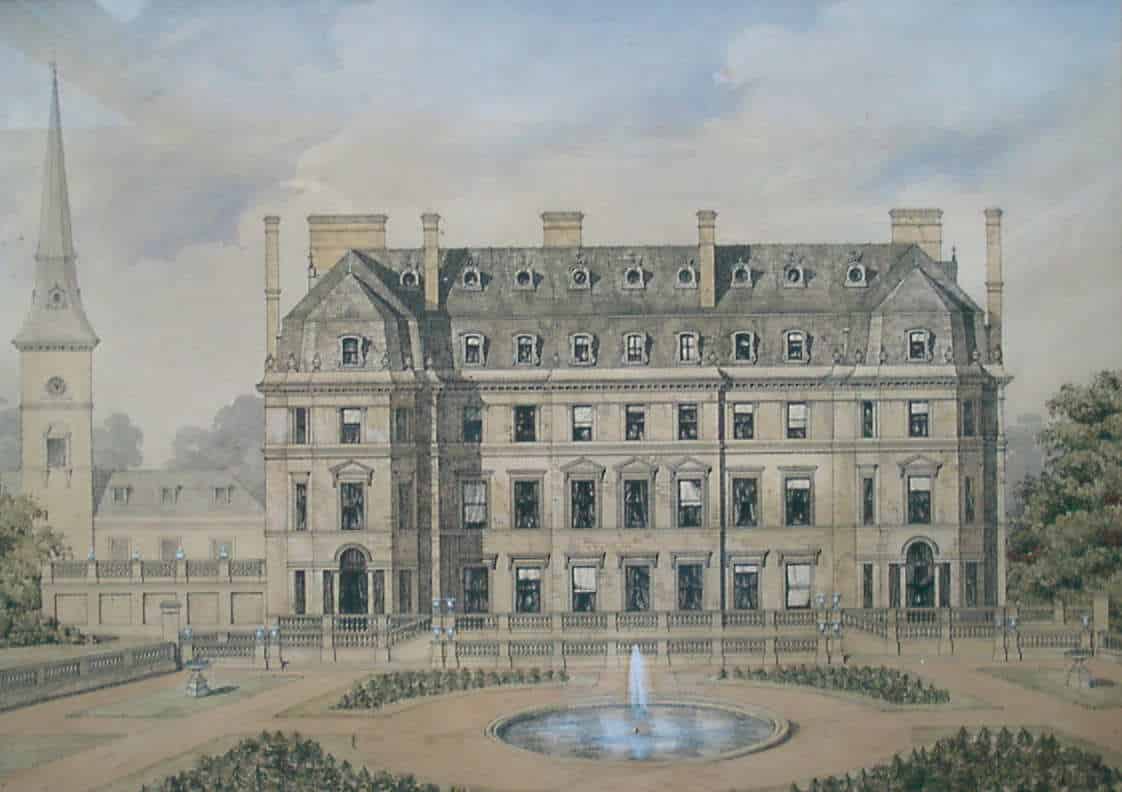
Isaac Lewis was born in Neustadt in Lithuania in 1849. He went to South African, in 1870. He arrived poor. He was one of the first to reach the Kimberley diamond fields. He joined Sammy Marks as partner, and began to build up a large industrial and financial business in the Transvaal in 1881.
The firm of Lewis & Marks controlled enormous land and mining interests of all kinds.
In 1873, Isaac Lewis married Sarah Ann Tickton, the daughter of a rabbi from Sheffield.
He died at the age of 78 in Capetown on 29 March 1927.
He is burried in the Jewish cemetry at Willesden in London.
From the Cape Argus, Tuesday, March 29, 1927
Mr Isaac Lewis, senior partner and one of the originators of the firm of Lewis and Marks, died in the early hours of this morning at his residence, Leeuwenhof, Cape Town, at the age of 78. He underwent two serious operations last year, and never wholly recovered., but he worked incessantly almost to the last.
Isaac Lewis was one of the last of the great pioneers in the great development of South Africa which has marked the last half century. He was born in the province of Kovno in Russia in 1849, and came to south Africa in 1870. It was just after the discovery of diamonds which first roused the country from its sleepy ages and started the period of rapid material progress which has not yet abated or slackened its pace, and in which Lewis only ceased to play an important part when he drew his last breath this morning.
From the Cape Times, Wednesday, March 30, 1927
Death of Mr Isaac Lewis
Romantic Business Career.
Industries Founded
The death of Mr Isaac Lewis occurred at his residence, “Leeuwenhof” , Hof-street, in the early hours of yesterday morning. Mr Lewis had been in failing health for some time, and was taken seriously ill about ten days ago.
Mr Lewis and his partner, the late Mr Samuel Marks, had established many industries in South Africa, and they were mainly responsible for the foundation of the Union Steel Corporation.
In later years Mr Lewis had, says Reuter, attended to the firm’s interests in London and on the Continent. It is interesting to note that one one occasion under the regime of President Kruger, the firm lent the Transvaal Rupublic a sum of £100,000.
It is understood that the demise of the late Mr Lewis will in no way affect or disturb the firm’s considerabe interests, nor those of any such companies with which they are associated, such as Vereeniging Estates, the Union Steel Corporation, Crown Diamonds, Swaziland Corporation, and their other interests.
Memorial Service
Reuter understands that at the implied desired on the part of the late Mr Isaac Lewis, his remains will be laid to rest along side those of his wife. A memorial service will be held at 5 o’clock today at his residence, “Leeuwenhof”. Henry and Roy, two sons of the deceased, together with Mrs Duveen, his daughter, sailed from Southampton on Friday in Walmer Castle in the hopes of arriving before the end came.
Mr Isaac Lewis’ Career
“Most Eventul and Romantic”
(By Prof. H. E. S. Fremantile)
The death of Mr Isaac Lewis brings to a close one of the most eventful and romantic of the many extraordinary business careers which have at once made it possible and been made possible by the development of South Africa in the last half century. Though his life has been prolonged well beyond the three score years and ten of the Psalmist, with him, as with the rest, death has broken off active mental energy and constructive impulse in mid-course before they have declared their full results and long before they have been exhausted.
So much done, as others see it. But so much to do, as he felt to the last. So end in countless fruitful beginnings a South African career which began to make itself felt when our main line stopped at Wellington and has continued to expand to till the present time, when Labour Ministers plan aerial posts from the great mining centre of Johannesburg, unnamed when Lewis landed in South Africa, to the great port of Durban, then blocked with apparently impossible sand.
Isaac Lewis was born in Neustadt, Kovno, in 1849. He came to South Africa, poor but fortunate alike in his abilities and in the moment of his arrival, in 1870 he immediately entered on business, travelling far afield and learning to understand the Boer people, with whom he ever afterwards maintained relations of cordial friendship. It was not long before he joined forces with his cousin, Sam Marks, with whom he entered into partnership, and made his way to Kimberley. About the same time [1873 – will need to confirm] he married Sarah Ann Tickton [often given as Tickson]. Never was there a happier marriage. Mrs Lewis died in 1921. Her husband’s devotion to her attended her whole life, outlived her and remained to the end the secret and sacred treasure of his heart.
At Kimberley
The partners of Lewis and Marks took their place among the early diggers at Kimberley, and were among the earliest claim holders in the Kimberley mine. They had considerable success and establsihed a good name for strainght dealing in a community in which that habit was not too common to be highly valued.
But they sold out eagerly and went on to the Transvaal. There they bought the farm Maccauvlei, on which the Free State side of the farm on which Vereeniging now stands, and at once began to mine coal, make bricks and plant trees. They were well received by the Boer people and the Government.
See also Press Cuttings Index.
Alois Nellmapius, a Hungarian immigrant, in return for a large payment, was granted “the sole right to manufacture alcoholic beverages from grain, potatoes and other products growable in the Transvaal”. Alois promptly formed a syndicate with Isaac and Barnett Lewis, and Sammy Marks, and they erected a distillery that they called “De Eerste Fabrieken in de-Afrikaansche Republiek” (the first factory in the South African Republic). President Paul Kruger declared it opened in 1883 and gave it the name “Volkshoop” (people’s hope). The discovery of gold on the Witwatersrand ensured that the distillery grew. It occupied a large site on Sammy’s farm, Hatherley, and was even listed on the London Stock Exchange.
Samuel Marks had interests not only in gold but also in coal, forestry, land, manufactoring and the production of outstandingly low-quality liquor.
The son of an impoverished and itinerant tailor from Lithuania, Marks’ first foray into business was hawking cheap goods around the Western Cape.
The diamond fields in Kimberley beckoned and he arrived with his distant cousin, Isaac Lewis, and a wagon-load of diggers’ requisites. They made their first fortune there, supplying the diamond diggings with coal from farms they owned on the Vaal River. Marks did not acquire a great stake in Witwatersrand gold mining, a blunder he later regretted, but he acquired other businesses: a distillery, glassworks, tannery, food-processing plants, a brewery and a brickworks, as well as shares in a number of other concessions.. He could speak the Dutch/Afrikaans spoken in the Transvaal and gained the ear and affection of President Kruger.
Though his formal involvement in politics remained limited, he attempted to mediate between Kruger and Rhodes, and forecast to Chamberlain that any war with the republics would be longer and far costlier than could be imagined.
Source: Illustrated history of South Africa: the real story. Reader’s Digest, 1995, ISBN 1-874912-27-0
Isaac Lewis (1849-1927), South African industrialist, cousin of Senator Samuel Marks. Born in Russia, he came to South Africa in 1870 and joined in founding the firm of Lewis & Marks, which became one of the largest landowning and industrial concerns in the sub-continent. His role, however, was less active than that of Marks, and he was less familiar to the public.
Senator Samuel Marks (1850-1920) South African industrial and agricultural pioneer. Born in Neustadt, Russia, he emigrated to England as a young man, where his first industrial efforts comprised the finishing of certain types of knives in Sheffield. In 1868 Marks reached the Cape where he spent his earlier years as a “smous” (travelling peddler). In Kimberley he attained early success and at one stage financed Cecil John Rhodes. With his cousin, Isaac Lewis, who followed him to South Africa, he set up the firm of Lewis & Marks in Barberton, and then moved over to Pretoria. With his headquarters at the famous Zwartkoppies Estate he gained the lasting friendship of President Kruger. He not only set up a model farm at Zwartkoppies, but began, at Hatherley near by, the first experiments in manufactoring, the place being appropriately known as Eerste Fabrieken.
Possessed of enormous vision, he tried his hand at projects as varied as brandy, jam, glass and canning. He opened up the first coal mines near Viljoen’s Drift and with Isaac Lewis established the town of Vereeniging.
At Maccauvlei he created one of the largest plantations of trees in South Africa. Following the South African War, he became heavily interested in the cold storage industry at the Cape, to supply the needs of the Rand mine compounds. As early as 1896 he had been attracted by the possibility of establishing a steel industry in the Transvaal, but did not achieve success until 1913 when the Union Steel Corporation of South Africa started its first blast furnaces at Vereeniging. Other industries established by Samuel Marks included the production of bricks and tiles and flour milling.
Appointed a senator after Union, he became famous for the shrewdness of his political judgement.
Source: Southern African dictionary of national biography, E. Rosenthal, 1966
1844
Birth of Samuel Marks who was to become Isaac Lewis’ partner in business.
1849
Isacc Lewis born in Neustadt, Lithuania. Father Samuel. Mother Dora.
1854
Barnet Lewis and Joseph Lewis born. Likely to have been twins.
1857
Sarah Ann Tickson [or Tickton] born.
1860
Fanny Rebecca Lewis born.
1866
Frederika Lewis born.
1870
Isaac Lewis arrives in South Africa
1873
Isaac Lewis married Sarah Ann Tickson, daughter of a rabbi from Sheffield.
25 September 1888
Gilbert Roy Lewis born in Hampstead.
13 May 1889
Alice Lucy Emma Cruerge born in Pau, France.
26 November 1912
Gilbert Roy Lewis marries Alice Cruerge in Paris..
18 April 1917
Basil Roy Lewis born.
1919
Sarah Anne Lewis dies at the age of 62.
1920
Samuel Marks dies.
21 May 1922
Diana Sarah Lewis born.
1926
Frederika Lewis dies.
29 March 1927
Isaac Lewis dies at Leeuwenhof, Capetown after a long illness. Age 78.
27 February 1928
Fanny Rebecca Lewis dies.
19 July 1928
Joseph Lewis dies
28 September 1929
Barnet Lewis dies.
27 February 1956
Stephen Roy Lewis born
16 February 1959
Christopher Roy Lewis born
1975
Gilbert Roy Lewis died in Cagnes sur Mer in the South of France.
18 August 1995
Oliver Roy Lewis born
Continue reading